What Color is Your Snowmachine?

Tags

, , ,

Gary and I made a final foray into Anchorage week before last. We had made what we thought would be our last trip the week prior—to get our snowmachine, skis for me, more flannel sheets, long underwear and socks, groceries, and anything else we might need in the coming months—but our snowmachine was held up at the port in Seattle, necessitating one last run to go get it.

It was just as well, too. The weather finally turned just cold enough for us to bring frozen foods back on our long drive. With highs around forty degrees, we could keep three large coolers’ worth of frozen food frozen and produce fresh in the truck bed. I grew up on canned goods like green beans, pears, and fruit cocktail (fighting with my siblings over the one-half maraschino cherry in the whole can) but had largely abandoned them in favor of the fresh produce available year-round in San Francisco. Here in our Alaskan pantry we have canned tomatoes, olives, corn, beets, pineapple; purees of pumpkin, butternut squash, and sweet potatoes; and even canned mushrooms. And, though days are shorter now, Alaska’s gardeners thoroughly exploited the long summer days. We stayed with Gary’s sister Karen and her family on the outskirts of Anchorage; they showered us with home-grown celery, carrots, tomatoes, eggplant, cucumbers, and peppers, and we bought apples, bananas, onions, and sweet potatoes. Everything made it home at more or less the right temperature. So the trip to Anchorage saved me from a winter of canned green beans.

Of course, what we’d really gone for was to get our snowmachine before we were snowed in─or out. Chuck, our salesman, promised us the snowmachine would be ready for us Friday morning, which meant we needed to leave on Thursday.

Closing up the cabin in cold weather is a big job. Before leaving we got a good fire going and brought in plenty of firewood and tinder for our return. I filtered lots of water so our ceramic filter could start drying Wednesday; we worried it might crack if it froze with water in it while we were gone. We ate the last of our onions and put the potatoes in a cooler with a sleeping bag wrapped around it for insulation, setting it not far from the wood stove. We did as much as we could ahead of time to allow for an early start, and were pleased to have made it to Karen’s in time to take a shower and read the paper before dinner.  We even had time to stop on the way to buy an eight-foot red sled for hauling lumber or camping gear with the snowmachine.

On Friday we got to Costco shortly after it opened and did the rest of our shopping before picking up the snowmachine. You can’t just leave something like that in your truck while you shop and expect it to be there when you get back, so once we had the snow machine one of us always stayed with the truck. Everything went off without a hitch—almost literally; we pointed out to Chuck he’d failed to install the promised hitch so we could pull the sled.  But by evening we had groceries, warm things, a snowmachine, and were back at Karen’s doing loads of laundry and watching movies with the family while Ella kept her eye on the family cat.

Snow began to fall as we made our way home Saturday, the truck bed packed full with the coolers tied down alongside the snowmachine.  We got home just as it was getting dark and woke to four inches of fluffy white on Sunday.

Gary took the snowmachine on its maiden run that morning to break trail on our driveway and around the cabin and outbuildings in order to pack the snow, making walking easier and setting a good base for skiing. But who wants to ski on the driveway? On Monday we went further afield to break some trail for real skiing.

Hunters and recreational ATV users have cut hundreds of “off-road” roads throughout the wilderness, exploiting what used to be a system of animal trails. We hate to see so many roads, but they do make for easy snow-machining. Gary drove and Ella ran alongside through snow untouched except for tracks of red fox, snowshoe hare, and caribou. Oh, and mice. Tracks of mice and voles are everywhere.

When we stopped after riding for ten or fifteen minutes, we looked down on the fog and up to the mountains, some sprinkled with snow, some covered. This will be beautiful skiing, I thought.
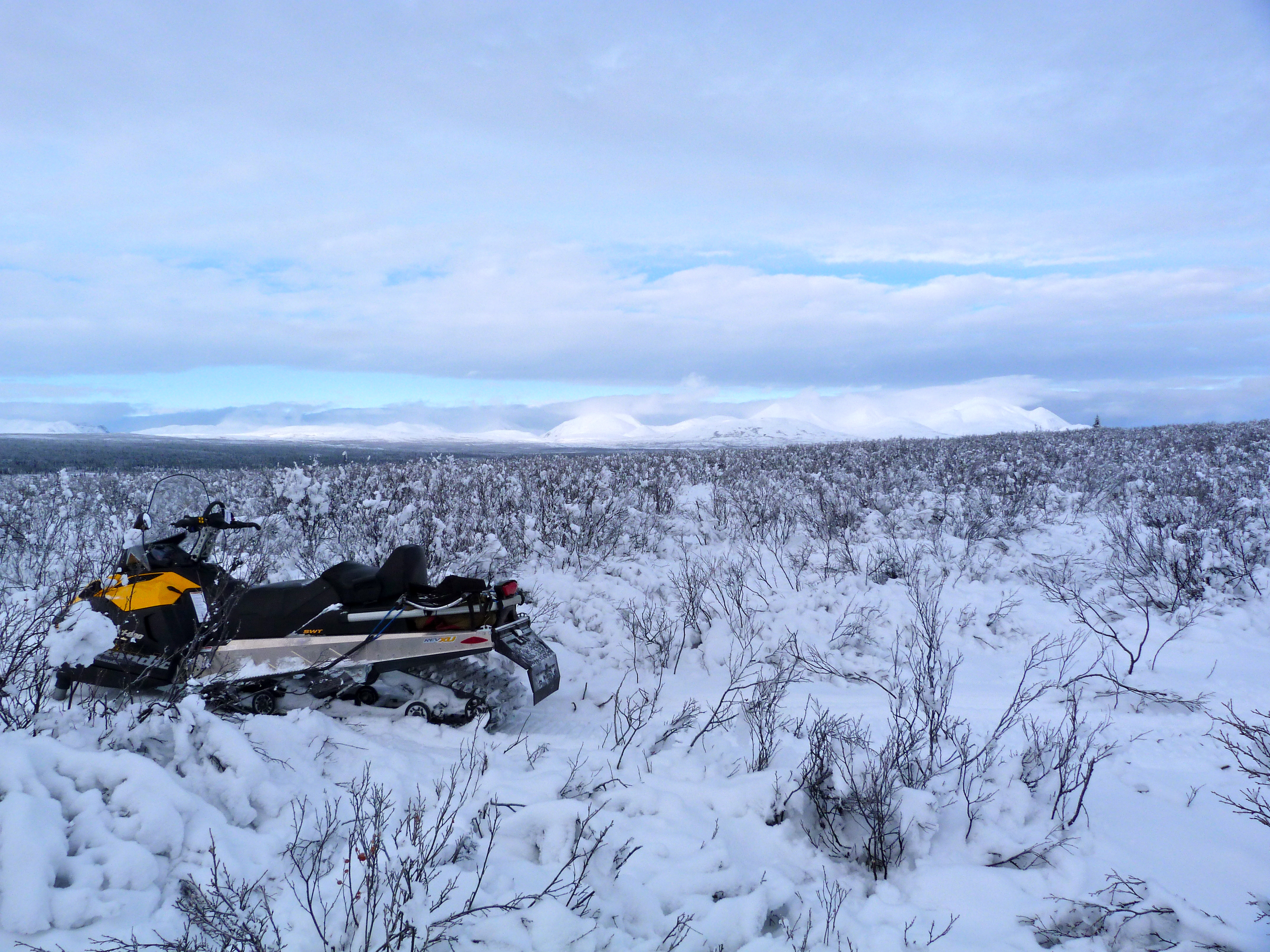
Our snowmachine is yellow! What color is yours?

We could only attend to the view when we stopped, though, because Gary was focused on trailblazing and I…well, I was having trouble paying attention. I had never ridden a snowmachine before. At the start of the ride I marveled to float past our icy creek, out the gate and down the road. When we turned onto the ATV trail leading into the woods, the snow didn’t fully cushion the bumps.  My ride went from nice to exciting.

Gary turned his head a bit and asked, “How are you doing back there?”

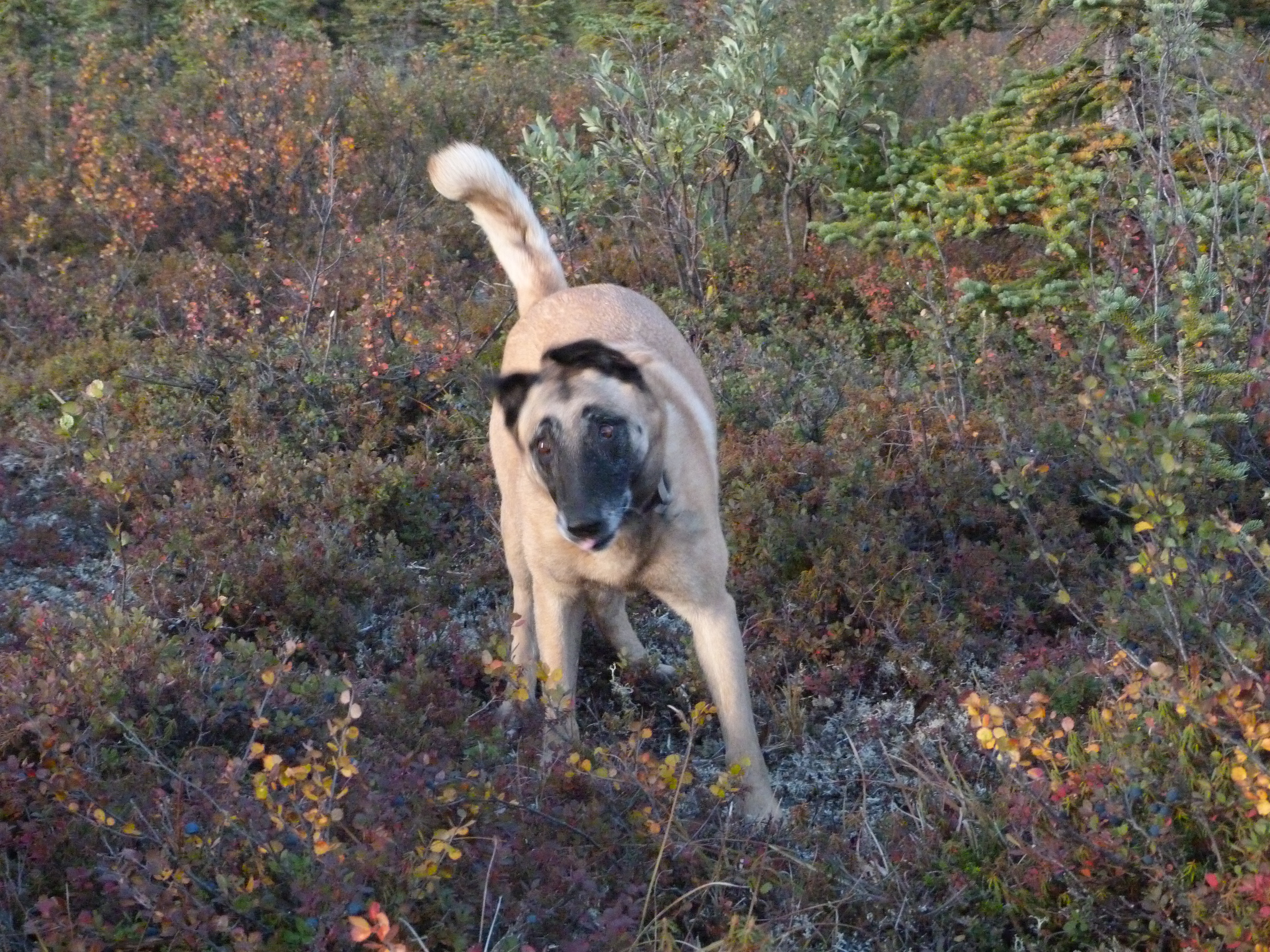
“Great!” I said. I was really having fun. Ella was having fun, too, racing alongside us with a smooth, elegant gait.

As we penetrated the forest, the trail steepened. The bumps were no longer reliably due to shrubs but often to snow-covered rock. I felt every muscle tense with each bump, as though riding a willful horse, and knew I would be sore in the morning.  I shifted my weight to avoid tipping. My breathing changed to what I imagine is taught in a Lamaze class.

“Whoa!” I screamed.

Gary stopped and turned his head.

“Sorry”, I said sheepishly. “I didn’t mean it.”

Closing my eyes helped, especially as Gary picked up speed to climb a ridge. But at a crucial point in the climb, I let out two more loud shrieks and he stopped again. Oops. Maybe a piece of leather to bite on would have helped me. Too late; the machine was stuck. I disembarked while Gary reversed out and could get going again.

To be clear, this is no racing machine. Its wide track makes it very stable, and we weren’t going fast, maybe ten or fifteen miles per hour, slower still when going over rocks or through snow-covered spruce branches. Gary insisted this was an easy ride. We made it back to the road without incident and rode toward our cabin. Ella and I were surprised when Gary slowed but went past our gate.

“Up!” he called to Ella.

Up she jumped, riding between his arms as he accelerated. Forty-five miles per hour seemed like a hundred to me, even on the road. About a half-mile from our turnoff, we stopped again. I could hardly pry my hands loose from gripping the passenger seat handles so long and hard in the cold.
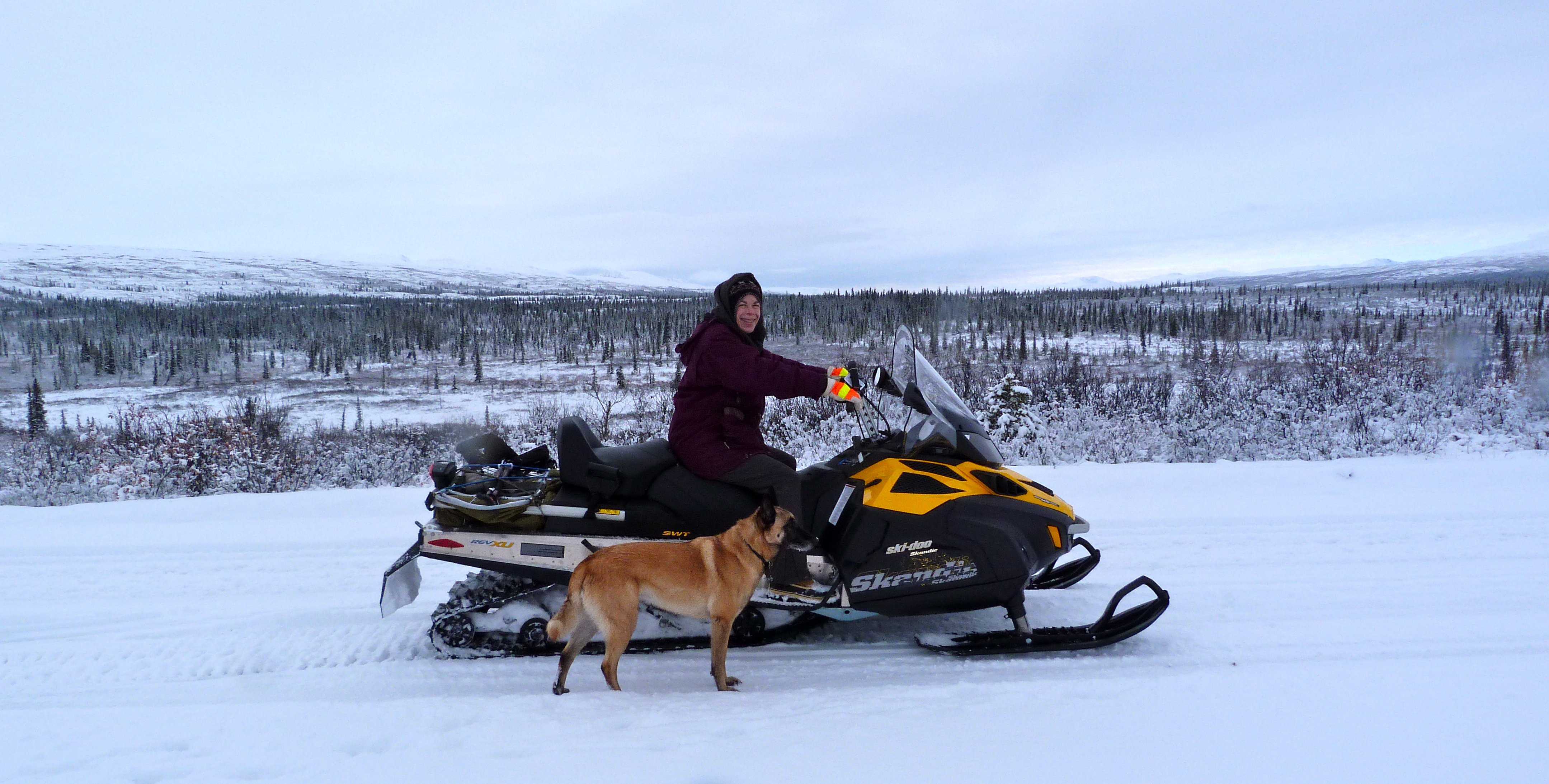
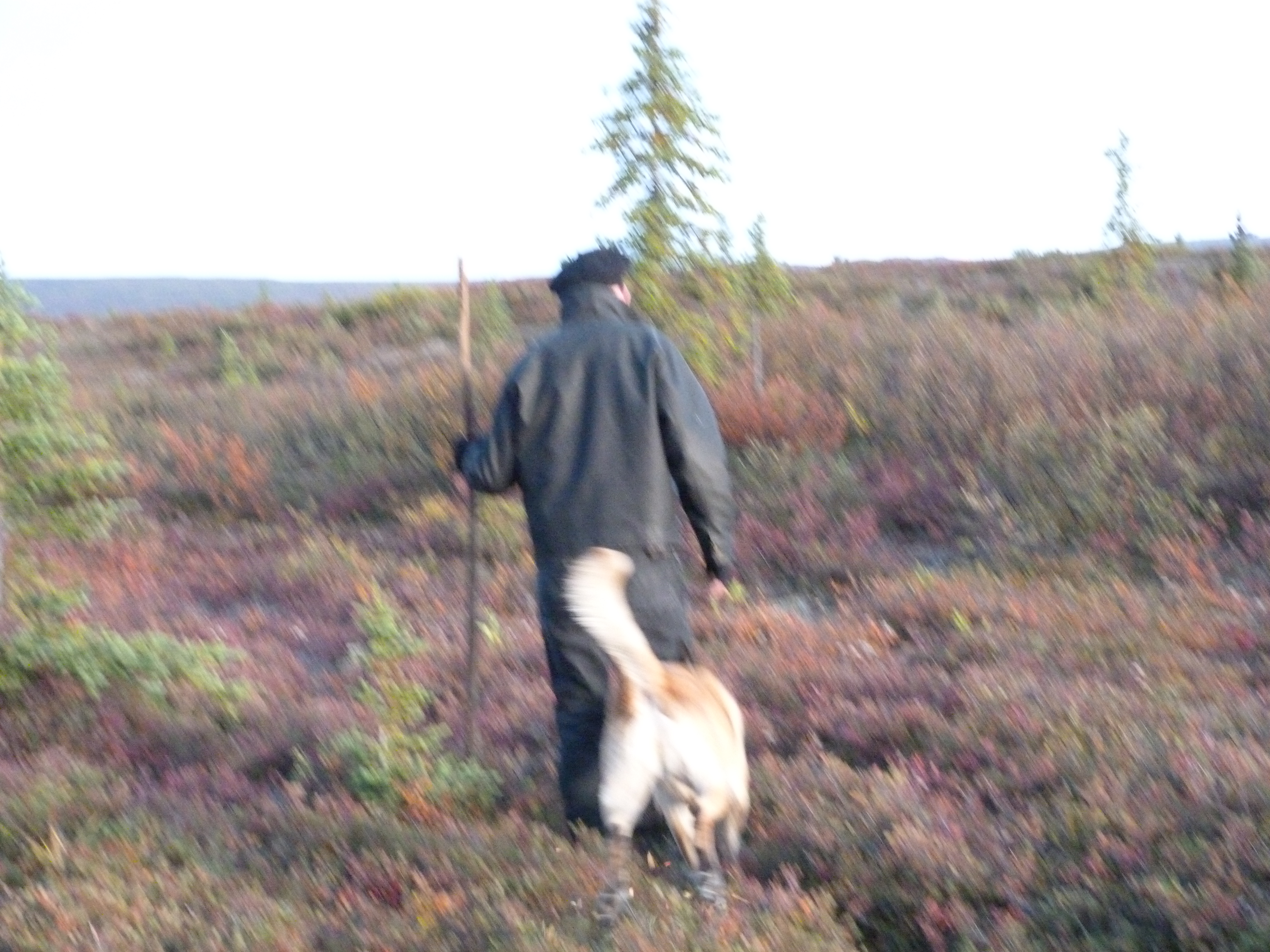
Getting ready to go for the first time!

“You’re driving home,” Gary announced, climbing off.

And so I did. Gary held onto me, and Ella ran alongside.

“Drive on the loose snow,” Gary suggested.

It was smoother than on the trail we had just made.

“Don’t go into the ditch!” he said, more urgently this time.

Then I practiced shifting gears. The machine made an angry sound because I failed to come to a complete stop first, but machine, people and dog alike survived. I couldn’t bring myself to test the machine’s speed past twenty miles per hour, which seemed fast enough. We moved fast through the cold air, then slower, then fast again. Ella kept pace. It was exhilarating and less scary than I expected.

Tuesday we went out again, this time carrying our new red sled. We explored a little more and loaded up the sled with downed, dry wood. It was a wonderful ride. What had my problem been? This was great fun! By tomorrow, I thought, I’ll be begging to drive.

Special thanks to Erin for the title, “What Color is Your Snowmachine?”

Sunrise: 9:11 a.m.
Sunset:  6:09 p.m.

Today's weather photo, snow and wind at noon. Note the red sled filled with (snow-covered) lumber!

Weather: High 38, Low 22, cloudy, snowy and very windy!
On Becoming Alaskan

Tags

, , ,

I’ve been in a hurry to switch my residency from California to Alaska. Of course I want to be treated as a partial-year resident for tax purposes, as there are no state income taxes in Alaska. An added advantage is that after one year I will be eligible for the Permanent Fund dividend, which could be a couple of thousand dollars per year. But I also wanted to get the California plates off my car. It seems the reputation of Californians in general and San Franciscans in particular is just as bad here as it is in Oregon or anywhere else–maybe worse.

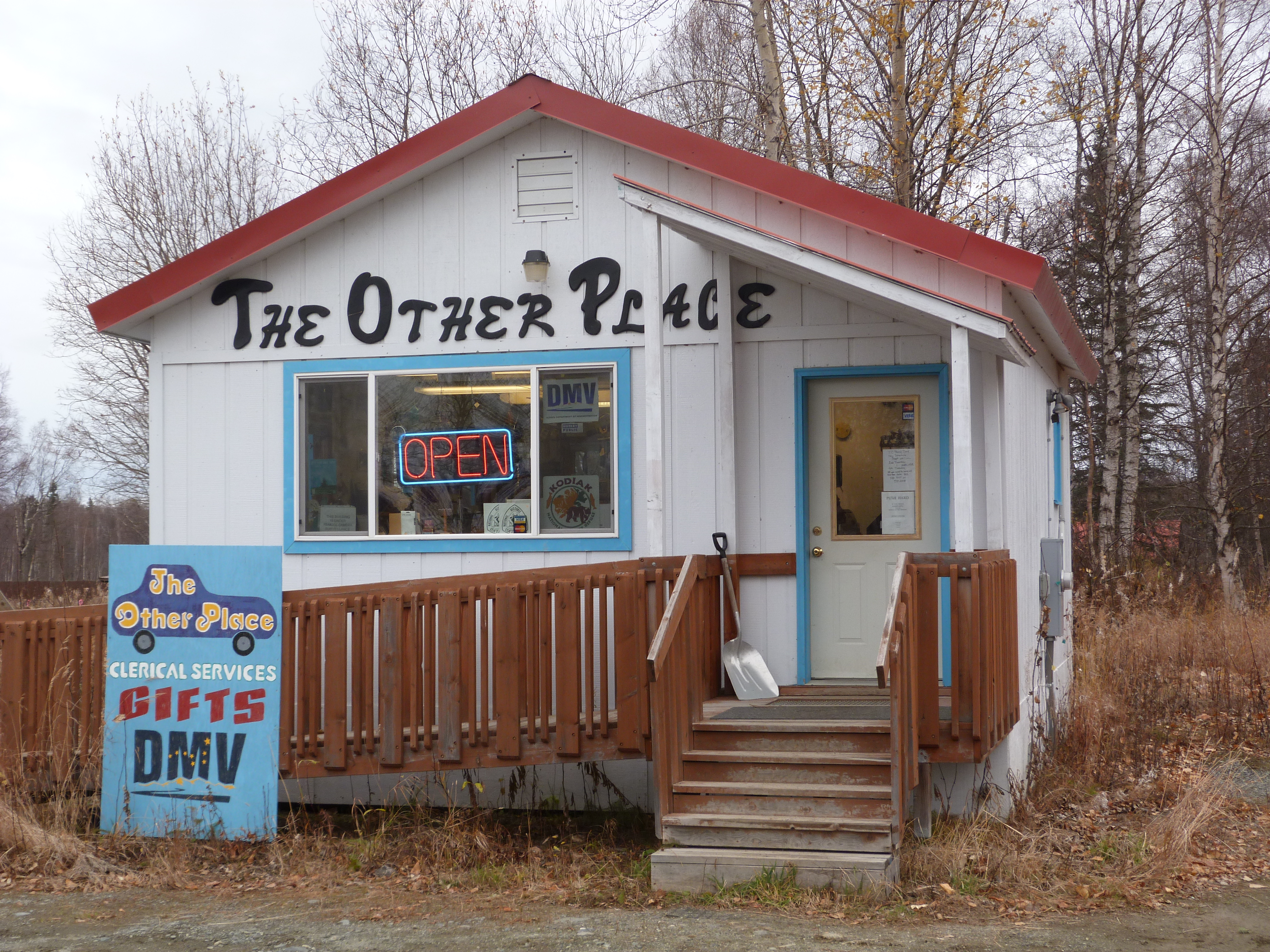
When we went to Anchorage a few days after my arrival to take Richard to the airport, we stopped in Trapper Creek to get my Alaska driver’s license and plates. The DMV there is a combination DMV and gift shop as well as provider of office services. The gift shop was small but nice, with some great wildlife cards and cookbooks specific to local fruit and game. I had plenty of time to peruse the merchandise, since several customers were ahead of me and the proprietor, Mary, served all functions.

This is our nearest DMV

A sixteen-year-old sat on a bar stool at the counter. Mary quizzed her on DMV test questions. The girl had already failed the test and this interchange wasn’t going to make a difference until she was eligible to test again, but Mary wanted her to learn how to think about the questions.

“What would be an example of less-than-ideal road conditions?” she asked the girl.

“I dunno,” the girl answered. In fairness, this kind of grilling in front of six or eight onlookers might not put me in a learning mindset, either.

“OK, think about a less-than-ideal condition for a Friday night date. What would that be? A big pimple just appeared on your chin, your hair isn’t doing what it’s supposed to do. What else? Now, this isn’t about a date, but can you think about what a less-than-ideal road condition might be?”

Mary was working hard. The girl was, well…let’s just say she was uncomprehending.

After about five minutes and several aborted attempts, the hapless teen successfully identified snow as being less than ideal for driving. This painstaking process was repeated for the remaining five questions the girl had missed on her test. I was not next in line.

When I finally got the nod, I pulled out all the documentation I thought I needed. Mary gave me the bad news that I needed my social security card and the title, not the registration, of my car. Still, she administered the test and gave me my completed paperwork.

“Take this to any DMV within the next 12 months with your social security card and title and they’ll be able to help you,” she told me.

I tried again at the Fairbanks DMV a few weeks later. Gary had gone through the ordeal with me in Trapper Creek, so this time opted to wait with Ella in his truck. The DMV was an oasis of calm compared to any other DMV I’ve been in, with just a few young drivers and unfailingly polite military personnel ahead of me in a quiet, spacious room with a video display running wildlife footage. Still, it took me an hour to get to the counter. All the workers seemed happy and friendly, save one: an otherwise attractive woman in her forties with a peevish look on her face. I felt relieved when the monitor above her station called for number 196. I held number 197. But number 196, from neglect or wisdom, failed to surface. I got the grouchy lady.

She insisted on reconfirming everything Mary had signed off on, although I didn’t have to take the test again.

“Proof of address?” she asked.

I confidently pulled out my cell phone bill, which Mary had signed off on.

“P.O. boxes are not acceptable. I need proof of your physical address. Mail, a utility bill, a pay stub from your employer,” she said.

Once I convinced her that I am retired and living beyond the service area of the U.S. Post Office and the utility companies, she sent me to wait for a manager. While waiting, I remembered I had arranged delivery of fuel from a company that had e-mail. The manager agreed that an invoice with the delivery address would suffice. But I would have to get it faxed in and start over in the back of the queue.

I never did hear back from the fuel-delivery people, but Gary suggested I contact Alaska Satellite Internet, the folks who had arranged for the installation of our satellite dish. While he shopped for the wind turbine, I called them. April promised to find my invoice with the delivery address and fax it to the Fairbanks DMV.

The delivery address is just the milepost on the road near our cabin. It isn’t an address, really. It isn’t in the town or even the borough where our post office box is, and we’re not actually on the road; it’s just what we tell people so they know where to start looking for us. But now it’s my physical address, complete with erroneous town and zip code.

An hour later we went back. The first fax was cut off and didn’t show my address. The second fax, same thing. I found a copy of the invoice on my iPad, but they would only accept it if I forwarded it to the manager. I did, but their system didn’t like my system and delivery failed. I was bounced back to waiting mode again and again. Finally, I asked April to put the delivery address on the cover sheet, and at that point even the manager was sufficiently tired of me to accept it.

Five hours from the time I walked into the Fairbanks DMV, I was the proud holder of an Alaska driver’s license and new license plates, and a registered voter to boot. The photo wasn’t horrible, considering it had been a while since I washed my hair. Then I saw it: the woman had added five pounds to my weight. At least some things in life are free!

Last week I got my voter registration card. No fools, the folks at the Division of Elections understand I’m not in the same borough as my P.O. box. So they’ve assigned me a polling place at the farthest reaches of my borough, over five hours away. I can’t wait to see how long it takes to get that fixed!

Sights and Surprises

It is not unusual to see military jets overhead.  But I was surprised to hear something I don’t think I’ve heard since elementary school:  sonic booms.  One night there were four, then two the next night.  On the bright side, my wood stacks are still standing!

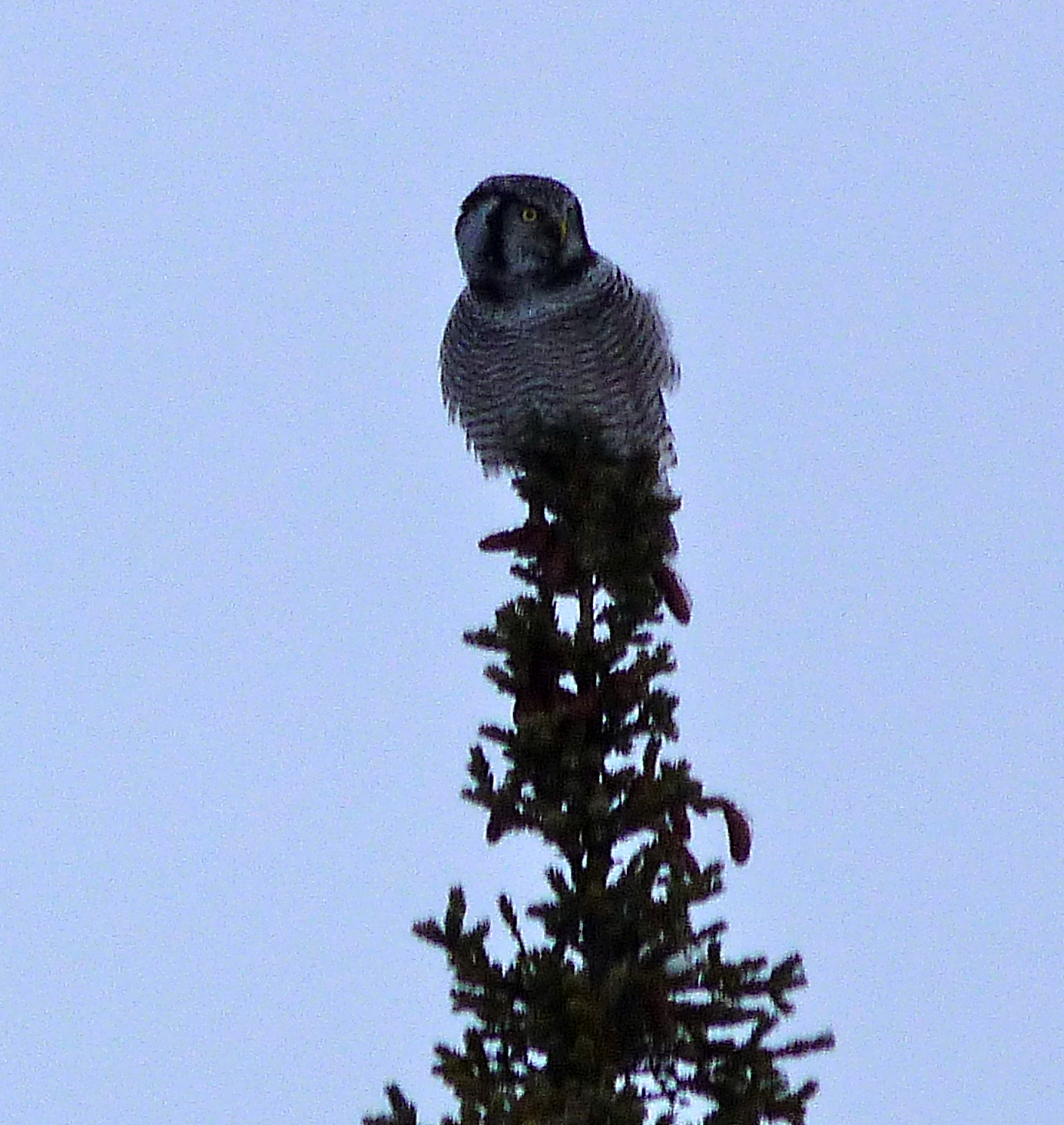
Northern Hawk Owl posing on a spruce on the hill just above our cabin

I didn’t see the Northern Hawk Owl that flew two feet over my head until Gary pointed it out where it had landed on the top of a spruce tree.

Dogs and dog mushers are in serious training mode now.

Look very carefully, and you'll see part of the dog team pulling an ATV

There is not enough snow yet for the dogs to pull sleds, so they pull ATV’s (all-terrain vehicles). This crew of about 16 smallish racing dogs was pulling two men in an ATV down the road near our cabin.  Judging from where we saw their truck (complete with kennel), they had a full day of it, about 60 miles round-trip.

Weather:  High 37, Low 28
Sunrise: 8:44 a.m.
Sunset:  6:38 p.m.

Aside

Missed Photo Opportunity of the Month

A cloudless night brought a cold still morning today. It was just above zero when I got up, blue and beautiful.

View from our hill on a sunny Sunday morning

I followed Ella up the hill, intending to capture the progress of the snows as they reach lower and lower. Each photo represented just a fragment of the panorama, and I had barely gotten started when my camera battery died.

Forced to savor the view without a viewfinder, I put my camera in its case and paused. Ella was lying beside me. I turned to the view behind me, and not thirty feet away stood an enormous caribou bull. He was approaching slowly, curious perhaps. His antlers looked to me like an elegant flourish rather than a weapon, but it did strike me that I was out-armed. Startled, I grabbed my walking stick, and the movement in turn startled him. By this time Ella was alert and heading his way. He didn’t flee, but he did turn away.  I had turned homeward, and we looked back at each other over our shoulders.

Another part of this morning's panorama

Weather:
High 44, low 0 degrees, sunny and clear all day

Sunrise/Sunset:
8:24 a.m./7:02 p.m.

It Was Bluish When I Sat Down on It

Tags

, ,

The blueberries had already begun to ripen before I left San Francisco. They grow in abundance, covering the tundra for miles around our cabin.

Gary and Ella lead the way to the best blueberry patches

Gary and other locals insist that what I consider abundant is in fact a relatively weak showing. But I come from the land of Whole Foods, home of $6 half-pints, so it looks like a lot to me.

Wild blueberries are even more nutritious than their domestic counterparts; they have more antioxidants and a more concentrated, tangy flavor.  Canned, these berries will be an important supplement to our winter diet—fresh fruits and vegetables will be in short supply.

Picking berries is fun for an afternoon, and somewhat less so after that. Still, if it gets tedious, it’s tedious in some of the most dramatically beautiful landscape I’ve ever seen, so I look around a bit too often and find I’m picking at half the rate Gary is.

Ella entertaining herself at full speed while we pick blueberries

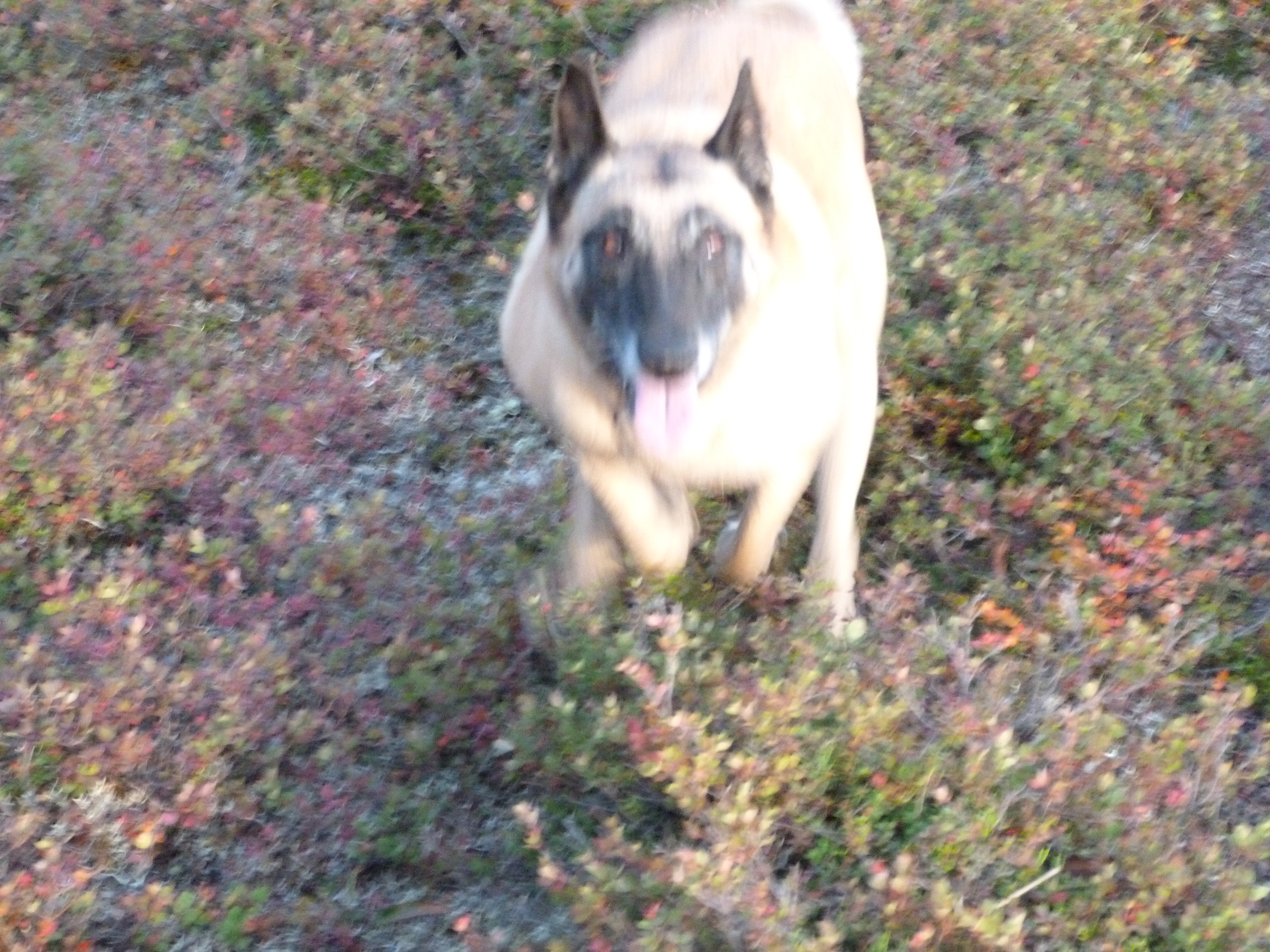
Ella gets bored, too, but does her best to stay occupied. Maybe she thinks the task at hand is to strip the tundra of all of these pesky berries. It seems that way when she plops down next to me and starts stripping the fullest branches of their fruit just before I can get to them. When she tires of eating blueberries, Ella runs in circles as fast as her legs can carry her, finishing at a dead run straight for me and knocking me over with kisses.

The berries grow low to the ground, so when I find a patch I like I usually settle in by sitting, which seems easier on my back. But even the most innocent-looking patch of caribou lichen hides fallen blueberries, and what is blue on the bush becomes distinctly purple on the seat of my pants. Oddly, it is green on my tongue. If you are told you are eating wild Alaskan blueberries, and your tongue doesn’t turn green, they aren’t the real deal.

It took a few hours to fill this bucket!

Heading home, we carry our buckets of blueberries high over the sunset-red dwarf birch brush to avoid getting extra leaves in the buckets. Wild blueberries should be cleaned of sticks and leaves as soon as possible after picking before they get soft. Gary showed me how they almost clean themselves if you roll them a cup at a time down the length of a cake pan. The berries roll, but leaves and sticks don’t. Berries that have been sitting too long in the fridge or those that have softened on the bush after an overnight freeze or two are more of a challenge. They don’t roll as well, and the minuscule leaves get stuck in the juice.

In the end we put up 13 quarts of blueberries in Mason jars, which Gary assures me is nothing to brag about. But this was my first time canning, so I’m bragging anyway. We canned them with a bit of sugar, ready to be turned into pies or smoothies or just about anything. But for the most part, we are likely to freeze the juicy contents of a jar in small batches, ready to eat as the perfect dessert around a warm winter fire.

Lowbush cranberry—lingonberry—season has come and gone. They ripen just as the blueberries are starting to soften on the bush. Gemlike amidst the soft green caribou lichen curling under spruce trees, it seems almost a shame to pick them. Almost. We put up nearly as many jars of cranberries as blueberries, saving some out to make chutney to go with our caribou and moose roasts.

The last blueberries are still out there, weeks after we declared the season over. Frozen hard these wintery mornings on bushes barren of leaves, they might be almost easy to pick now. Every morning I promise myself I’ll go out and pick just one more bucketful.

Sights and Surprises

We drove to Anchorage in an unsuccessful attempt to pick up our snowmachine. On the Parks Highway past the Talkeetna spur road, between No Dogmushers Road and the turnout to the Gigglewood Lakeside Inn, a bald eagle soared just above us. The iconic bald eagle images we see every day are so much smaller than life.

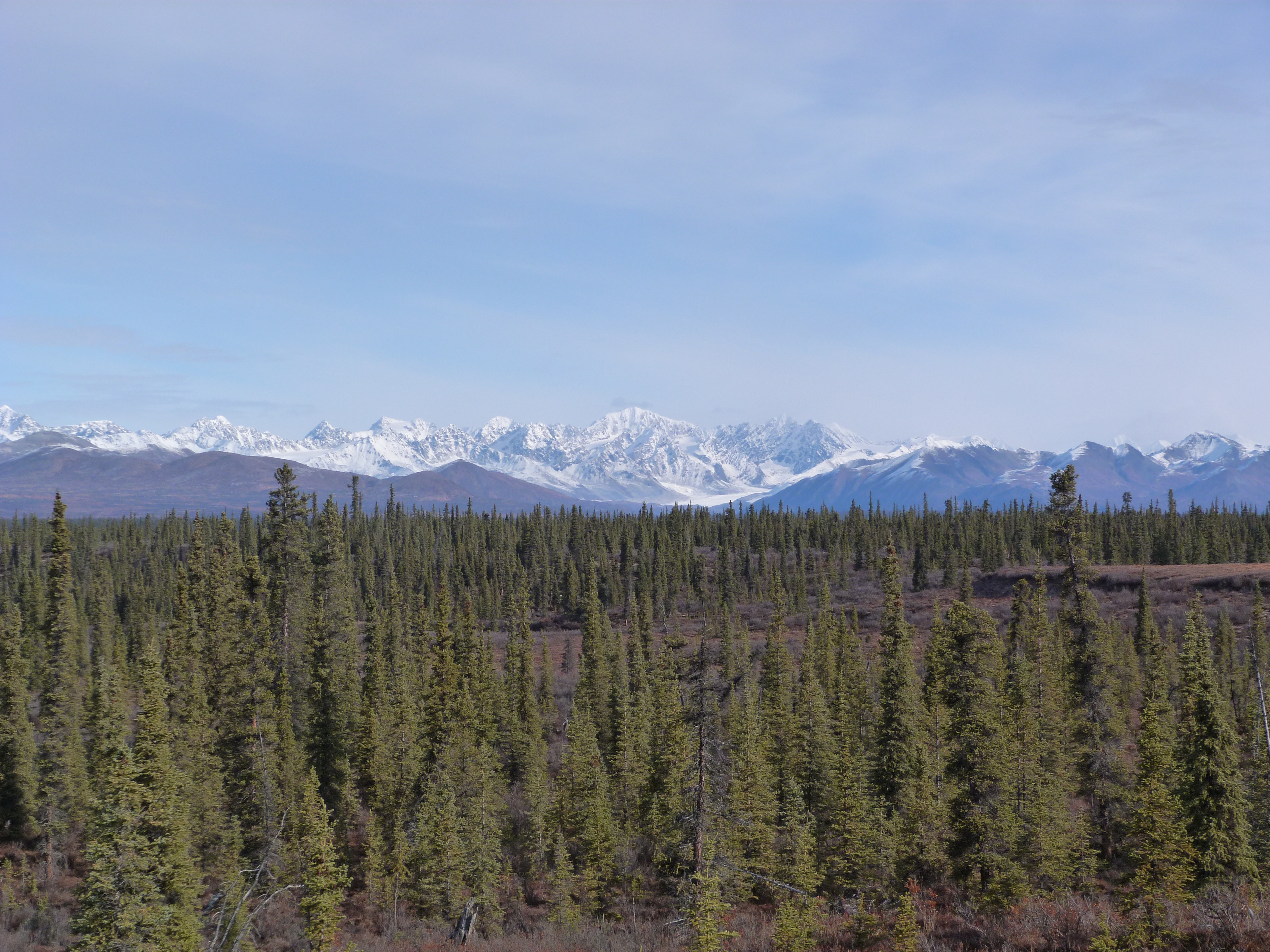
View toward Denali yesterday

Driving back yesterday, we had some dramatic views toward Denali.

Weather:  High 42, Low 28
Sunrise:  8:22 a.m.
Sunset:  7:05 p.m.

Aside

First snow!

Snow started just before 9 this morning. I took this picture at 11:15. Then we got really busy clearing up the yard of things we might not be able to find again until Spring. But it’s clearing now, and most of the snow has melted away.

It's snowing!

Complex Solutions for a Simple World (Part II)

Tags

,

I came here knowing that winter transportation would not be simple. We have a snow machine due to be picked up late next week and just hope we can get it here before the snows arrive. My Subaru now has a battery warmer, battery blanket and coolants that won’t freeze until the temperature hits 55 below zero. Friends who live where the pavement starts about thirty miles from here have agreed to let us park at their place and plug into their power. All I need now are my snow tires and a space heater to heat up the engine.

Then, once there’s enough snow, we can drive an hour or two into town where the gas station is the grocery store; you can get any flavor of moon pie there, but don’t even think about an apple or a banana. If we have time to plan, we can email friends in town to pick up what we need when they go into Anchorage or Wasilla or Fairbanks. Otherwise we have to warm up the car and drive a good five hours to get to Anchorage and Costco.

Today's view of the mountains; the snows are coming down lower.

What I didn’t realize is that this is a last resort. If we go to Anchorage or Fairbanks, everything will freeze at home while we’re gone. Apples, potatoes, and onions get mushy once frozen. So do many canned goods. We won’t even have the refrigerator for protection; it will be turned off when it gets too cold to keep the windows vented to prevent carbon monoxide build-up. Anyway, it’s not much needed in the winter when there will be cold spots in the house where we can place things we don’t want to freeze.

Next week when we go to pick up the snow machine, we’ll be making our last pre-winter grocery run. Every day I think of something I’m afraid to live without. How many cheeses can I keep through the winter? Do tortillas freeze well? What about freezing eggs? Are you supposed to crack the yolk or not? Is there such a thing as dried cream, or can I freeze it?

Here’s a question for you: what would be on your shopping list if you hoped to get by for four months without making a trip to the grocery store?

Well, at least some things are simple. What could be more simple and basic than water from the beautiful creek that runs through our property?

We’re not free of the risk of giardia here, so we have to filter or boil our drinking and cooking water. In the summertime we pump water at the campground down the road. BLM workers dismantle the pump after the end of hunting season, which was September 20th. So, on the 18th I took all my empty five-gallon water buckets to fill only to find the workers had come early this year. We’ve ordered a large ceramic gravity water filter, but meanwhile we’re using a Brita-type filter rather than go through the time- and fuel-intensive boiling method of purification.

When I was planning my move, I learned a lot about the logistics of daily life from the questions friends asked me.

A couple of months ago at work, Claudeen asked, “Won’t the creek freeze in the winter? Will you melt snow for water?”

Oh. I hadn’t thought of that.

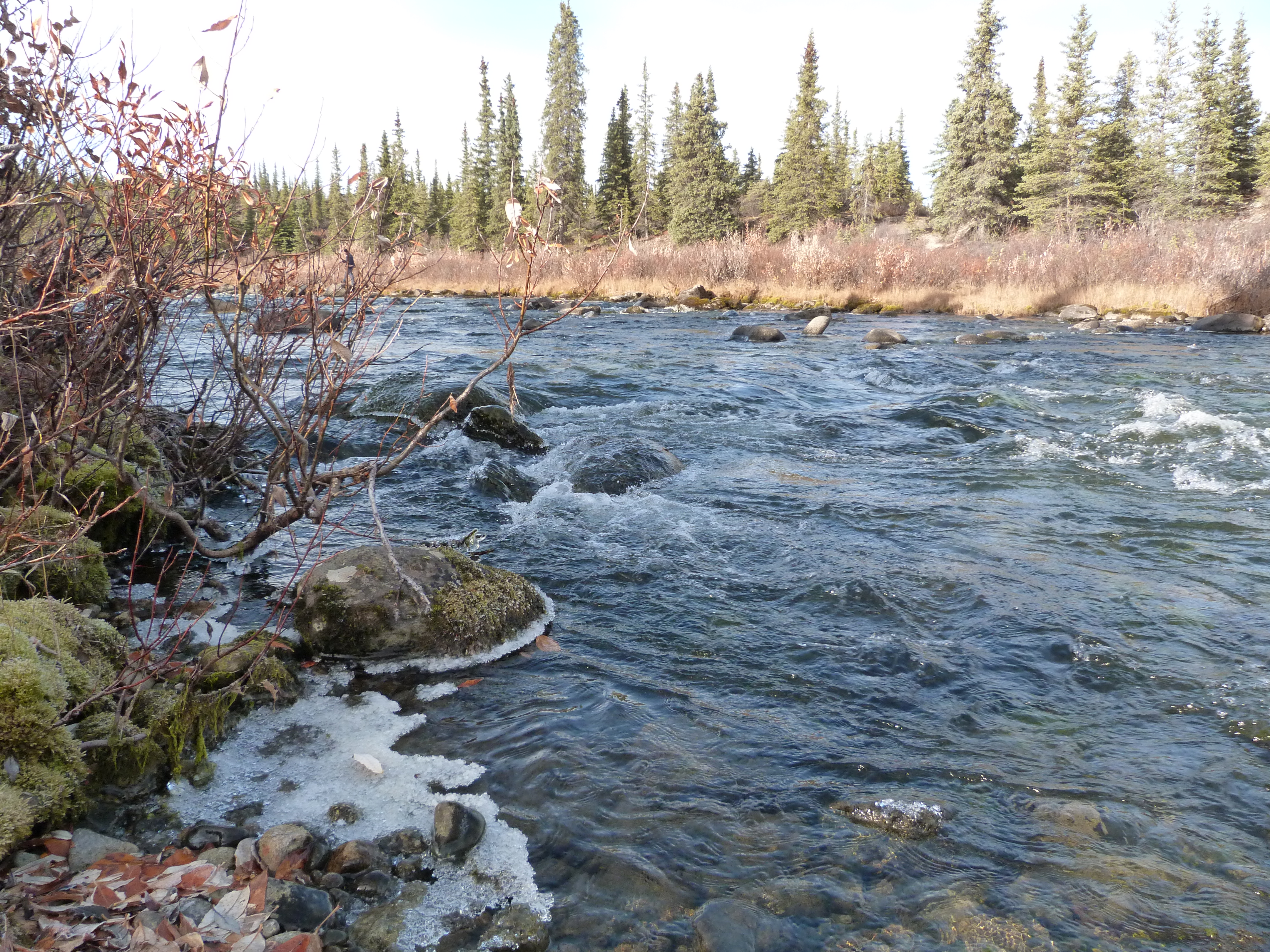
I went to get water at noon today and found ice along the creek's shore!

Bad news: the creek does freeze in the winter. Good news: it doesn’t freeze solid. So we will take an ice axe, cut through the surface, and fill our buckets. We could melt snow, but it takes five gallons of snow to get one gallon of water, times the seven or so gallons of water we’re using each day. That would be tedious, especially since we’re in an area that doesn’t get much snow.

Compare the seven gallons of water we’re using to the fifty or more Gary and I were using each day in San Francisco, and you can imagine what a challenge it is to keep things—and ourselves—clean. So we are particularly conscientious about staying next to godliness at least for the stuff that counts. We wash dishes in near-boiling water with the help of thermal gloves. A couple of drops of bleach go into the rinse water. Our evening routines include good sponge baths using hot water and a variety of washcloths for various parts of our bodies. The wet washcloths are then hung over the wood stove to dry.

Rub-a-dub-dub

To wash my hair, I bend over a metal tub while Gary pours warm water over my head. While shopping in Fairbanks a few weeks ago, he vetoed the juicy apple shampoo (“bear bait”) in favor of shampoo labeled “ocean breeze.” The tub is just big enough to sit in for a bath and requires a fair amount of water, so baths are an occasional treat/hassle. But my shower should be ready to use soon.

The other day I tried washing my clothes.  Sheets and towels pretty much have to wait for a trip to town, but we wash smaller items in a five-gallon bucket using a metal agitator that bears some resemblance in appearance and function to your basic toilet plunger.

Ella with the "washing machine"

Ella couldn’t take a picture of me using it, so this is the best I could do.

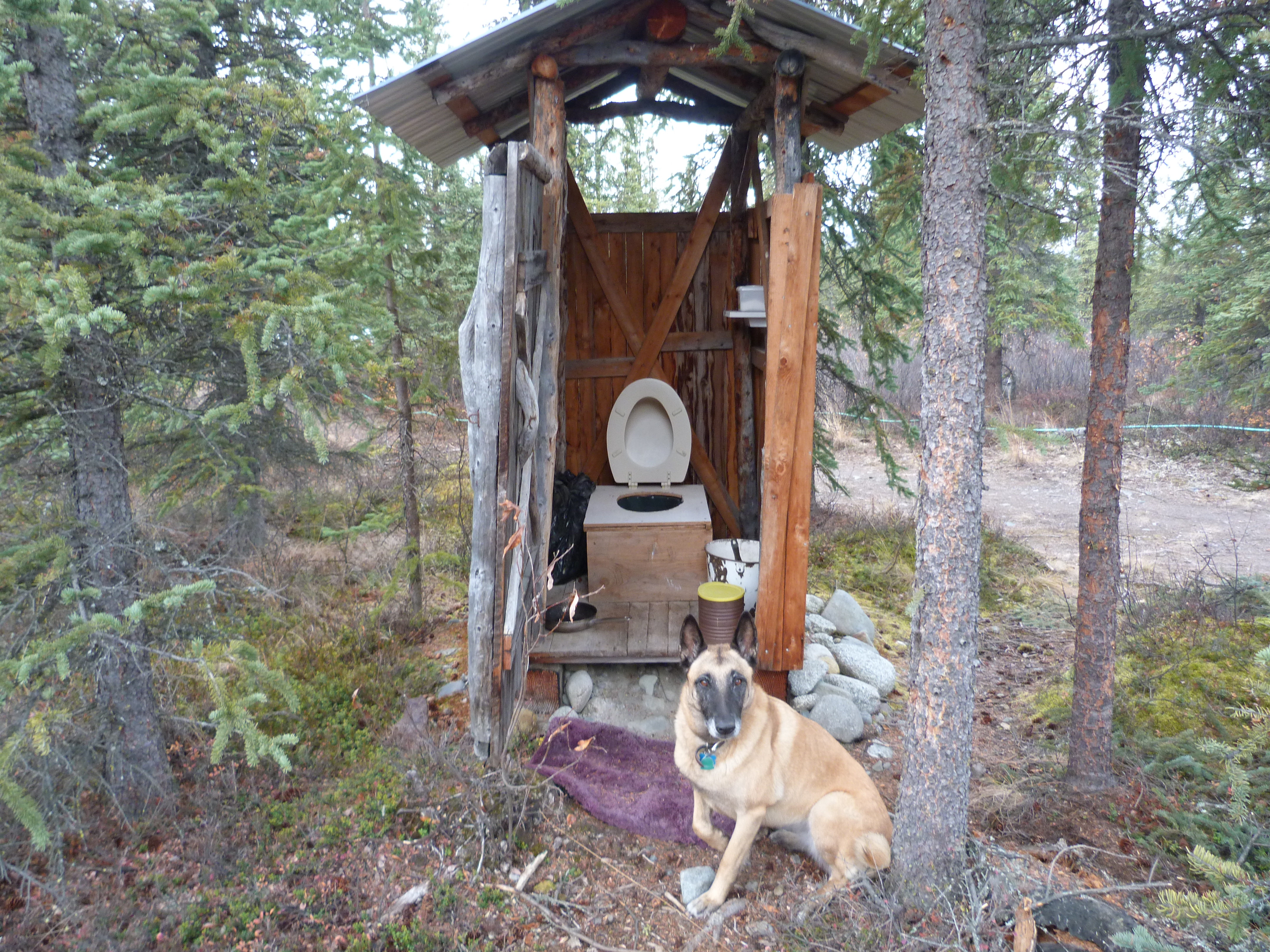
In the months before I left San Francisco, a number of my friends expressed intense curiosity about how I would be dealing with basic hygiene and bodily functions. It’s another thing that’s more complex than I imagined. I knew we had an outhouse, but what I didn’t know was that because the water table is so close we’re using a 55-gallon tank. Is that big? How long will it last? I really don’t know; the only way to find out is the hard way. What follows may be too much information for some of you, and it’s more than I really want to write. But inquiring minds (you know who you are) need to know.

Once the tank is full, we will bury it and dig a hole for another tank. That’s not something we want to do more often than necessary, so Gary explained the protocol for using the outhouse. Mainly, I don’t get to pee in it. It’s not unusual, first thing, to find Gary, Ella and I outside together (well, not too close together) having our morning pee. Given that in my prior life I couldn’t abide having a bathroom door ajar when the toilet was in use, this has required an attitude adjustment.

Ella gets a biscuit for accompanying us to the outhouse. Before you can say "Who wants to go poop?" she is on her feet ready to go!

But there’s more. It turns out that toilet paper takes up unnecessary space in the tank, so it has to be burned. Gary keeps matches in a coffee can in the outhouse together with the toilet tissue. A small skillet is there, too, for our burning convenience. Next to the toilet is a bucket of ashes from the wood stove. We spread a scant half-cup of ashes into the toilet after each use to keep down flies and odor, and it’s actually very effective.

To avoid getting ashes on the toilet seat, the seat needs to go up after every use. This was the source of some confusion on my part. You see, Gary had told me the outhouse was a simple squatter—basically just a hole—but in anticipation of my arrival he built a box for it. The box was rough-hewn and uncomfortable; the risk of splinters and falling in seemed very real. But I was happy to have a seat so I didn’t complain. After a few weeks here, I found a standard-issue toilet seat on the box. Gary had been busy building the woodshed, so I didn’t know when he could have installed it, unless…and yes, sure enough, the seat had always been there, but in the up position. I just never noticed it. Every so often I still catch Gary laughing about it.

Well, if the simple life isn’t always so simple, it does have its advantages. At least we don’t argue about who will clean the toilet!

Sights and Surprises

You know the wood I was stacking last week? My fourth stack tumbled down!

“Something there is that doesn’t love a wall, that wants it down.” Robert Frost was right. Gary suspects my workmanship, but I think it was an immutable force that brought down my fourth row of wood. What a mess!

Gas (regular) $4.60 per gallon.

The northern lights! Last night I saw wonderful plumes and curtains and bows of cloud-like light in subtle shades of purple and green. Just at the aurora’s peak, though, I got scared. Out with Ella near our vegetable garden, I heard the sound of a distant animal-skin drum and rustling that seemed to be coming closer and closer! Ella wasn’t scared, but I ran back inside. This happened two more times, as I was drawn against my fears to the beautiful sight. Today I discovered that the watering can, when kicked, makes a drum-like sound. Inside was a red-backed vole, plump from eating all our veges before drowning last night. I’ll spare you the photo.

Porcupines! Sorry, they’re shy. Shyer than I am, apparently.

Sunrise: 7:51 a.m.
Sunset: 
7:43 p.m.
Weather:
High 45 °  Low 14°
Sunny and clear; a few clouds rolled in late this afternoon, bringing enough breeze to (briefly) run our wind turbine, which was successfully installed in the rain on Saturday!

Complex Solutions for a Simple World (Part I)

Tags

, ,

Ah, the simple life: partaking of the beauty and bounty of nature. Free as a breeze.

Gary hoping for no wind as he installs the turbine

The breeze—our new Air Breeze wind turbine, that is—is neither simple nor free, as it turns out. The tower was free; friends in town happened to have an old one. Gary hurried to dig a three-foot hole before the first hard freeze and fixed the tower’s base in cement.

We knew we were in trouble as we struggled to get the next 10-foot section of this metal tripod settled onto the base, which topped out at about seven feet above ground. Heavy and unwieldy, it waved awkwardly in the air and threatened to crash before we got it settled. Gary thought better of simply trying to muscle up the next 10-foot section; he affixed a pulley rope so I could assist. The tripod had to be lifted up above the 17-foot target, then down very carefully. Gary looked awfully vulnerable even tied in as he was to the tower and ladder. We decided three of the four sections would have to be enough, and counted ourselves lucky to get that third one fixed without a major mishap.

That turned out to be the easy part. I tried to find something useful to do near, but not too near, as Gary hooked up the turbine. Ella was nervous too, and I couldn’t distract her even with a game of fetch. Eventually we discovered the turbine didn’t work, and Gary had to take it down. He was not happy. After failing to get anything more helpful than a ticket number from customer service in response to our e-mail on Monday, we drove into town Thursday to call tech support. We got someone live, but after running several tests this past Friday, we were back in town again on Monday to ship it back for repair. It will take weeks to get it back. Meanwhile, we’re losing about an hour of sunlight every week, so we ordered a second turbine and are having it delivered to my cousin Glenn, who will bring it this weekend when he comes to close up his cabin for the winter.

The complexity of the simple life didn’t escape my former colleagues. When I was planning my move, the logistics of daily life were a staple of conversation at work.

A couple of months ago in the lunchroom, Ashley asked “What about energy? You have a back-up generator, don’t you?”

I knew we had solar, but I hadn’t heard anything about a back-up generator. Now I know: we have solar panels on the roof, propane for the stove and refrigerator, propane and battery-powered lamps and, yes, a gas back-up generator. In addition to the new wind generator, Gary‘s expanding the solar array; he also bought a larger gas back-up generator. We use wood for heat.

Some of you have heard the story about the wood. Dave, the gas-delivery guy, told Gary that someone named Mel might deliver logs out our way. Mel has a phone but no e-mail; Gary has e-mail but no phone. So I called Mel from San Francisco back in July. We talked a few times about the price, delivery, and the mix of birch and spruce, settling on 75 percent birch, which burns hotter, and 25 percent larger-diameter spruce Gary could mill for lumber. Mel needed to know if he’d be able to pull in and turn his 60-foot trailer truck around on the property, so I called Dave, who had just delivered some fuel.

Ella checks out the wood delivery

“Tell Mel he’ll be able to turn around fine,” Dave told me.

Mel was happy to hear it and confirmed, “That will be $2,100 cash. We should be there Tuesday or Wednesday next week.”

“Cash? As in a check, or would that be cash-type cash?” I asked.

“Cash.”

“Oh. OK. I’ll make sure Gary will be ready for you by Tuesday.”

New woodshed under construction.

There’s an ATM in town an hour away, but no bank. It would take Gary several trips to town to withdraw that kind of money. So what else could I do? I got the cash, put it in an envelope, put the envelope in a magazine, put the magazine in another envelope, and sent it.

But wood, source of warmth and light through the ages, that’s still one of the simple things in life, right?

Here I am tossing split wood toward woodshed for stacking


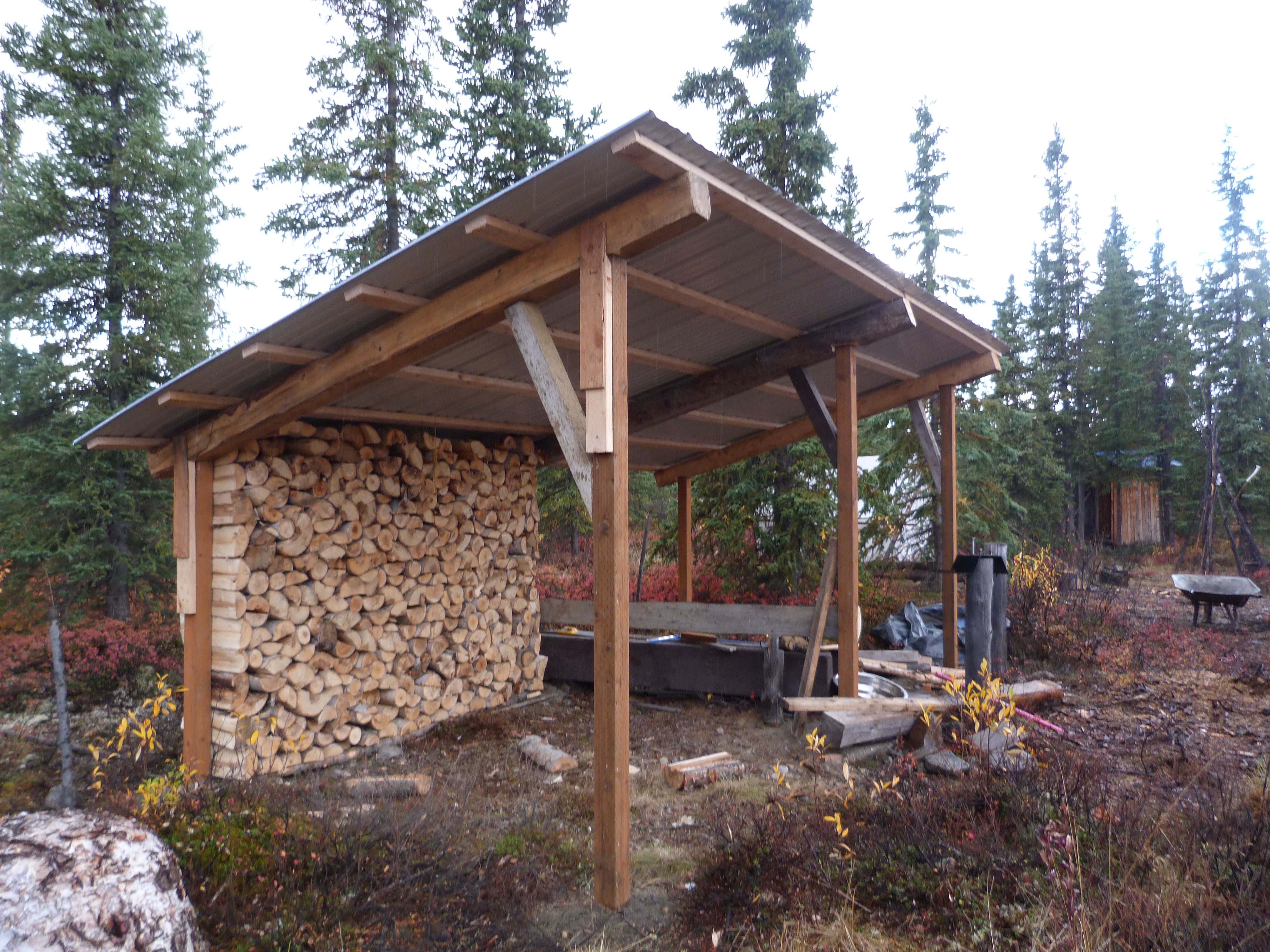
Well, Gary had to build a third woodshed, which at 8-feet by 16-feet now looks to be too small by half. Every day he cuts logs with his chainsaw until it runs out of gas and then splits the wood with an axe. My job is to toss it into the truck bed, drive it to the woodshed, and stack it. It’s all ready to use–well, it will be next year, after it’s dried. This wood was just logged and is still green. Since we can’t wait until next year, we’ll use Gary’s supply of well-cured spruce to get the green birch burning.

Next time: In Part II I’ll talk about the complex simplicity of some of the other logistics of daily living: water, washing and (for those of you eagerly awaiting or wanting to avoid the topic), the whole outhouse thing.

Sights and Surprises

We went to town Monday to mail off the defective turbine; then on to the local bar/café to do some laundry and—since we were there—take a shower. There’s a whole story for another time about our experience in what is one of the least likely places for any sort of exercise in cleaning. That ordeal over, we dropped in on some of Gary’s friends. I’ve met about three percent of the town’s population now; these are wonderful people with a culture of real hospitality.

At the first home, our host warmed our coffee with whiskey—to help me warm up from the near-freezing shower. By the time I finished my second cup I was plenty warm. We stayed on for a hot and spicy bowl of chicken soup, and I noticed a Canadian Jay and several birds I didn’t recognize at the red feeders hanging just outside the kitchen window. Suddenly I realized that one of the feeders was a rib cage, maybe 18 inches long, and the other looked to be the vertebrae of the same animal, whatever it was.

The next home we visited was small even compared to ours, but our friends—Gary’s friends, my new friends—somehow found room for a banana tree, which had survived many winters in its indoor garden.

It was after 8 that evening when we got on the road to go home.  Gary had told me that the sure way to see a moose was to leave the rifle at home.  He did, and we did! An enormous moose cow crossed the road right in front of me. No risk of an accident, though, at the slow pace required on our little highway!

Sunrise: 7:34 am
Sunset: 
8:04 pm
Weather:
High 55 °  Low 35°
Cloudy morning, sunny afternoon


Making It Home

Tags

, ,

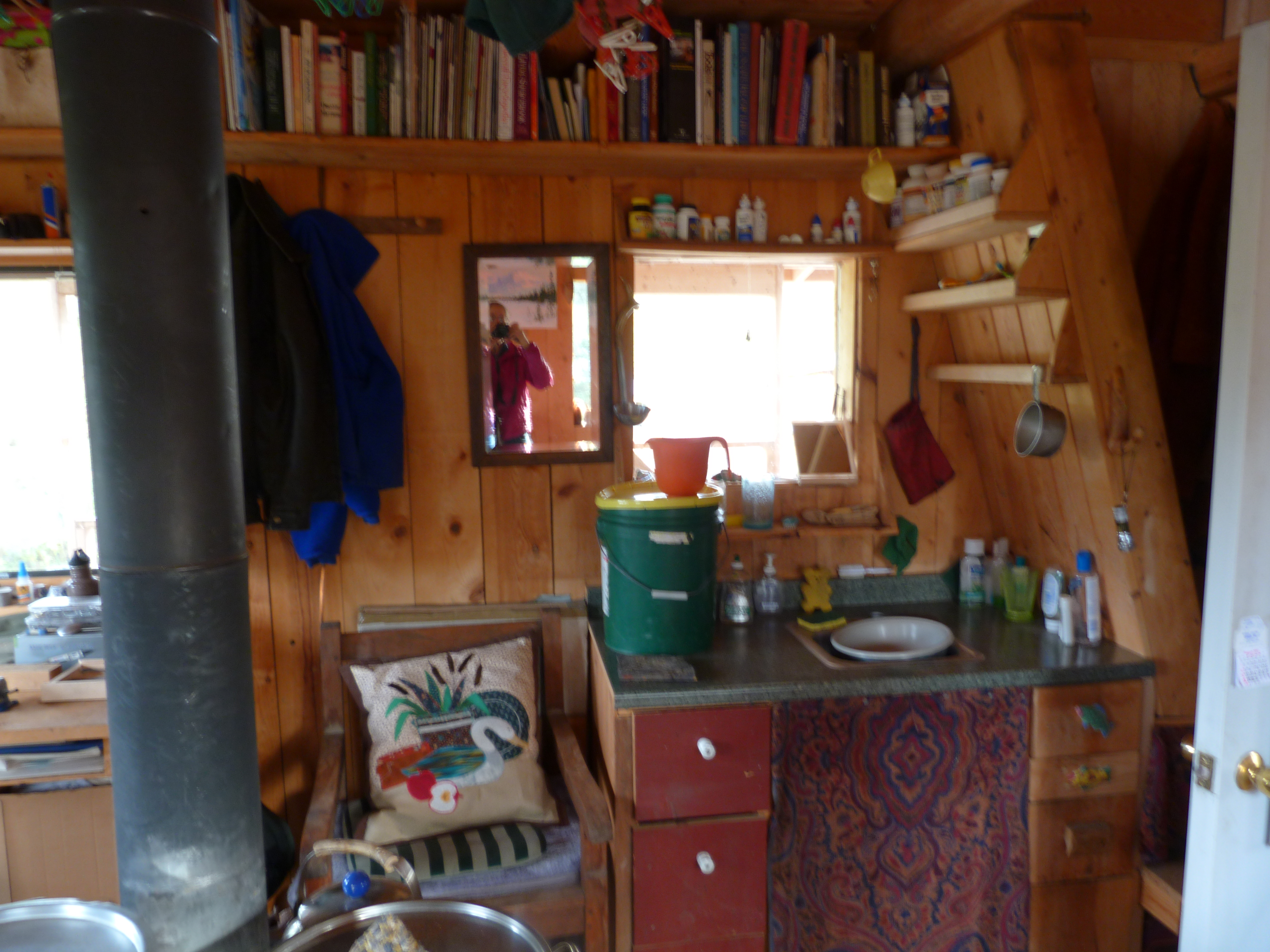
It’s a small cabin with sky-blue metal roofing. You don’t have to look closely to see it’s been built in installments. Gary added on to the tiny original building years ago, moving the kitchen and adding a porch. A new addition is underway; he’s building me a shower and adding storage.

After months of anticipation, I am excited to see my new home. Stepping in the front (and only) door for the first time, I find myself in a full kitchen with a sink, propane refrigerator/freezer and—to my surprise—a propane stove (I thought we only had a wood stove).

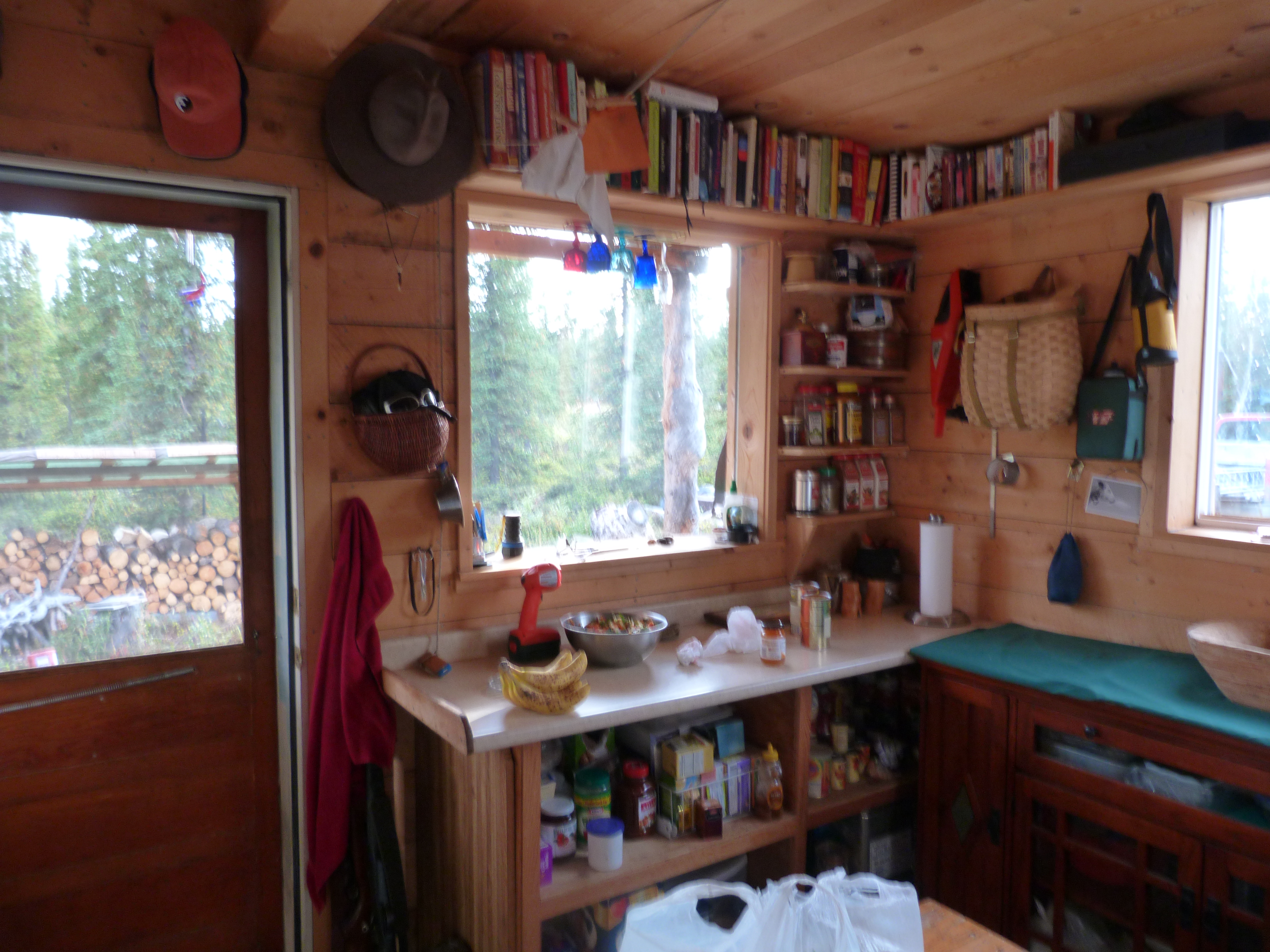
The kitchen has plenty of counter space and storage but just a tiny, faucet-less sink. On the floor next to it are two, five-gallon, covered buckets of water; two well-dinged metal pans–one a bit larger than the other–hang above them to ladle water for dishwashing or cooking or drinking. In summer months we pump water from the campground well nearby; otherwise it comes straight from the creek, and we will have to filter or boil it for most uses.

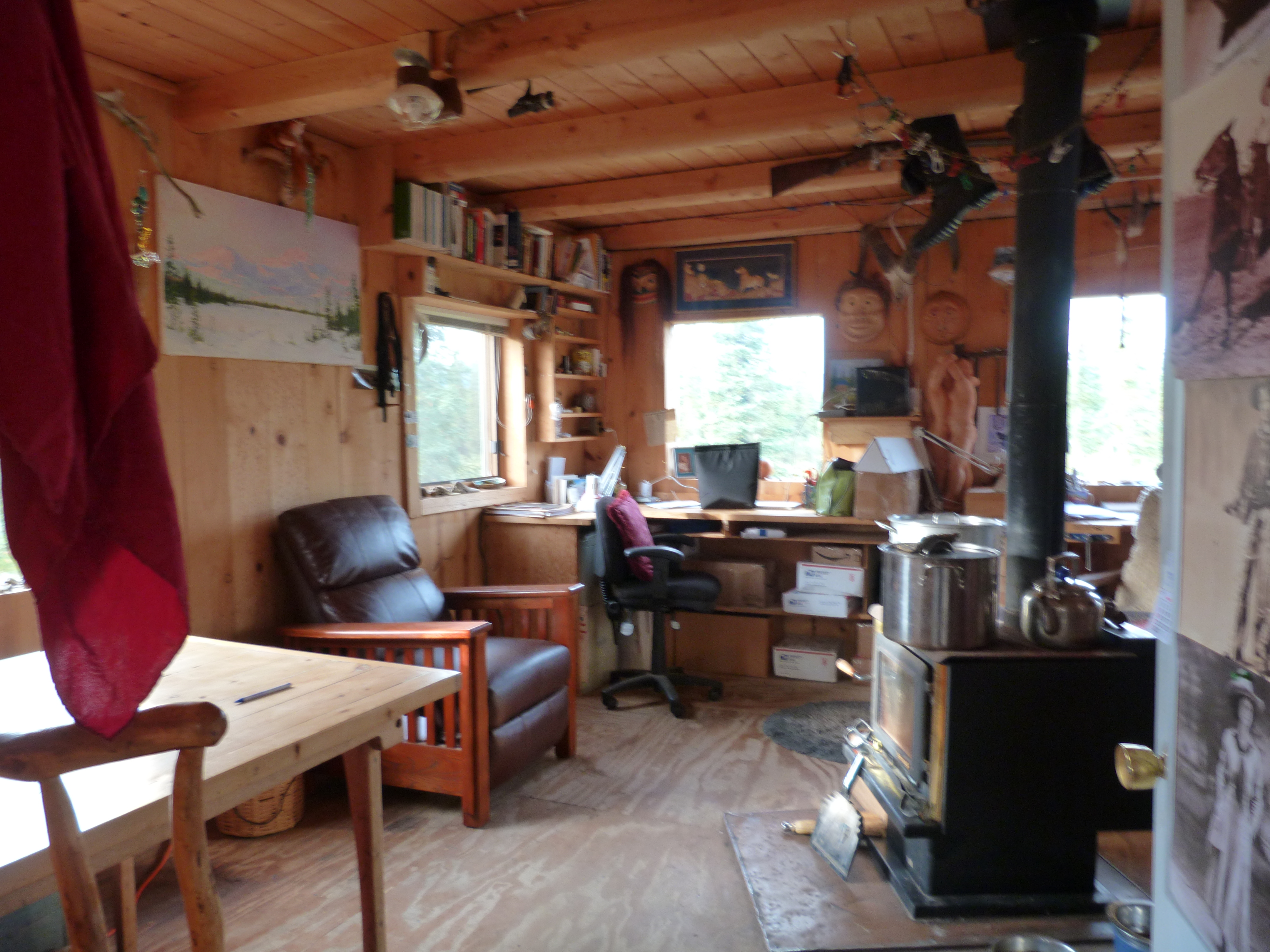
As I step into the main room, the view grabs my attention. Windows on all sides take advantage of the glorious setting, with the most dramatic being the Alaska Range to the north beyond an expanse of tundra and spruce.

Looking around the room I notice how each wall, beam, and bench, each space under a counter, table or sink, is storing something. No fewer than six fishing rods hang on the ceiling beams; boots, jackets, wet socks, tools, towels and kitchenware hang from the ceiling, on walls, over the stove, and at the tops of window frames. I see my books among the many lining the shelves along the uppermost part of the wall. Along with my books, I had mailed part of my large collection of boots ahead, and find them hiding in a small chest under the dining table. Though the table is small, Ella’s bed fits under it too. It will take me a year to discover all the art hanging on the walls and in every window and corner.

We keep huge stockpots of water on the wood-burning stove centered in the main room. Soon we will keep the fire burning throughout our waking hours, but days are warm enough now to let the morning fire die and heat water on the stove.

A long wide desk-height counter runs the full width of the cabin on the north side, with two rows of shelving underneath.  I use the left side for my workspace, and Gary has the right side for his. On the wall opposite the dining table is a sink—a bathroom sink, but for want of a bathroom.

I climb six steep ladder-like steps to the bedroom loft, bumping my head on arrival.  Even so, my first impression is that the room is huge. The loft shares the contours of the A-frame roof sheltering it, and its high ceiling peak makes up for the low outer edges. There are no closets; storage consists of trunks and cardboard boxes under the bed and beneath shelves built along the low walls of the room.  Only the chimney coming up from the wood stove below interrupts the sense of openness.

We read long into the evening without artificial light. It used to make me crazy when, in our San Francisco apartment, I would find Gary reading in the dimmest evening light; now it seems natural to conserve when we don’t know whether tomorrow will bring sun for our generator. Last week Gary put in a lamp over the dining table, a big improvement over the propane lamp that is dim and too high for me to reach.

You can’t go home again. But when you go there for the first time, is it home yet?

My mother used to say, “It takes a heap o’ livin’ in a house to make it home.”

I see all the work Gary’s done to create space for my things, to make a place for me.  Knowing how much I enjoy my showers, he set out to build me one. He’s worked hard these last three months to make this a place we could call home. For a few days I did feel like a guest, unsure where things were, where they went, or even how to manage washing the dishes or bathing. But the care that shows itself in all that has been done or is planned for my comfort, for our comfort—that is the heart of a home. I still have a heap o’ livin’ to do here, but this spot of light and warmth in the wilderness is fast becoming my home.

Driving Miss Lazy

Tags

, , ,

My brother, Richard, volunteered to fly out from Atlanta to make the long drive from San Francisco to Alaska with me. It was his bride Gloria’s idea. Gloria has too much good sense to think it was smart for me to make the trip alone, and is too generous for her own good. I accepted Richard’s offer before Gloria could find out how long it would take to both make the drive and give Richard a couple of days respite before heading home.

“I said you could borrow him, not adopt him!”

She was joking, but just.

Richard and I drove for nine days. Actually, Richard drove for nine days. He drove more than 4,000 of the 4,375 miles from San Francisco while I nodded in and out of consciousness like someone who had retired during the Nixon administration instead of last week.

Those final weeks in San Francisco had taken a toll: physical, mental and emotional. Packing on nights and weekends, I looked at everything I owned to decide whether to take, store, sell, donate or dump. There must be some equation explaining how hundreds of small decisions are the equivalent in stress to a number of much larger decisions. The weekend before we left I rented a trailer, hired a guy to help me load it, and drove my furniture and everything non-essential to life in Alaska up to Oregon for storage. Between the packing and work and goodbye dinners I was already exhausted, and with the trailer the seven-hour trip took me ten hours. When I got back I had one day to get out of my apartment. It took three. With no bed and no apartment, I was lucky to have dear friends who put me up and put up with me and all my remaining belongings and even, on that last night in town, my brother! At work I tried to tie up all sorts of loose ends I had successfully procrastinated during my 15-year tenure. But that wasn’t the hard part. Leaving my friends and colleagues, knowing that however close we remain it will never be the same – that was the hard part.

The road trip itself was a lot of fun. When else would I ever have had the chance to spend so much time one-on-one with my brother? We laughed, cried, talked about our shared past and saw the same old stories through new eyes.

On the way we saw stone sheep, bison, black bear, moose, caribou, fox, coyote, deer, free-range horses, trumpeter swans, osprey, northern harriers and a bald eagle. And sometimes they saw us.

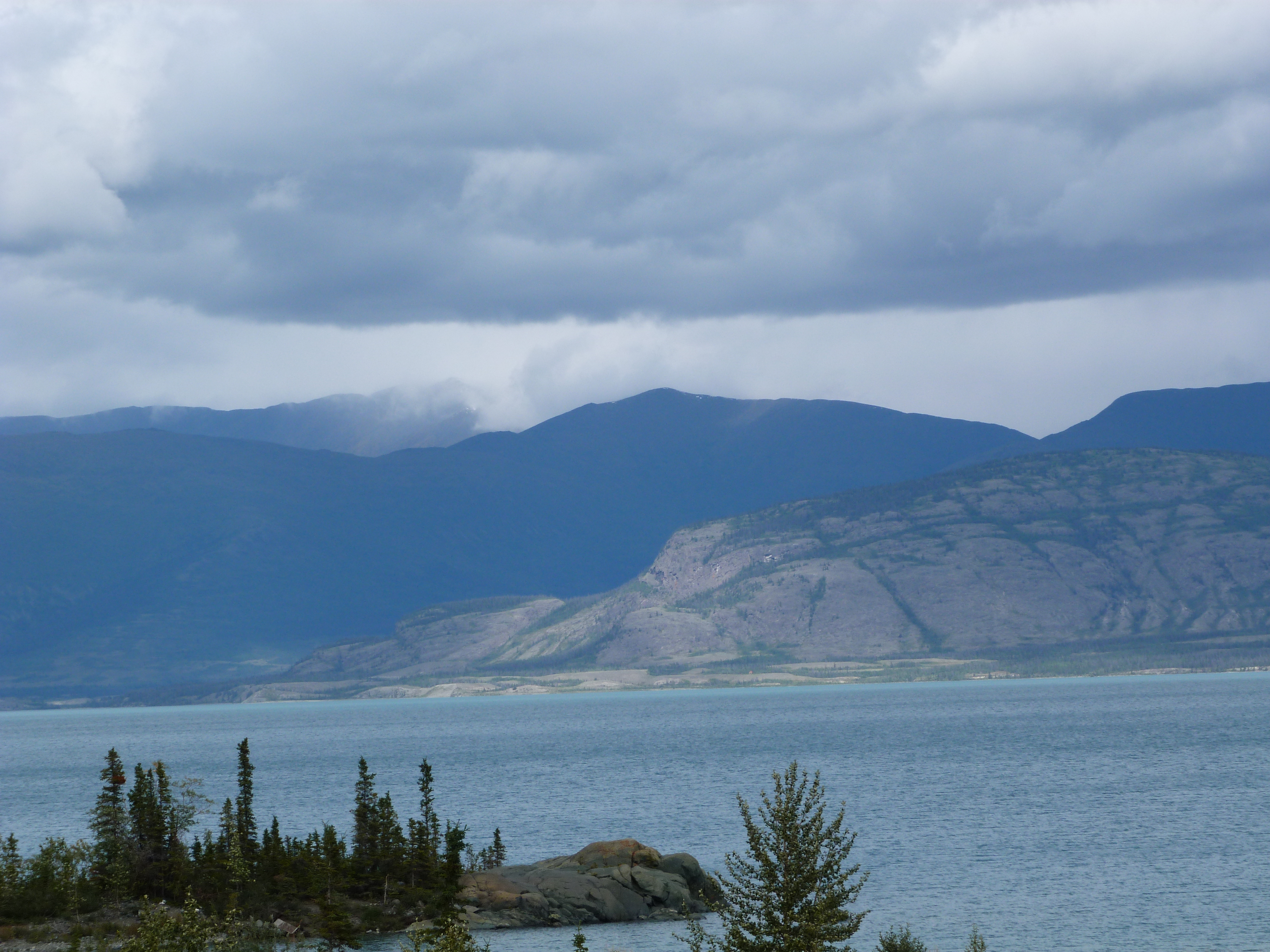
If you ever drive from the lower 48 to Alaska, you will find you have many routes to choose from. We were visiting friends and family in Washington and Montana, so crossed the border near Great Falls, Montana. Not knowing exactly how long the whole trip would take, as we headed into Canada we decided against the scenic route via Banff and Jasper along the Columbia Ice Fields. Instead we headed past Edmonton, Alberta to Dawson Creek in the Yukon, which is Mile Zero on the Alaskan Highway. Neither of us had seen Muncho Lake or the Liard Hot Springs in the northern part of the Yukon Territory, so we headed that way.

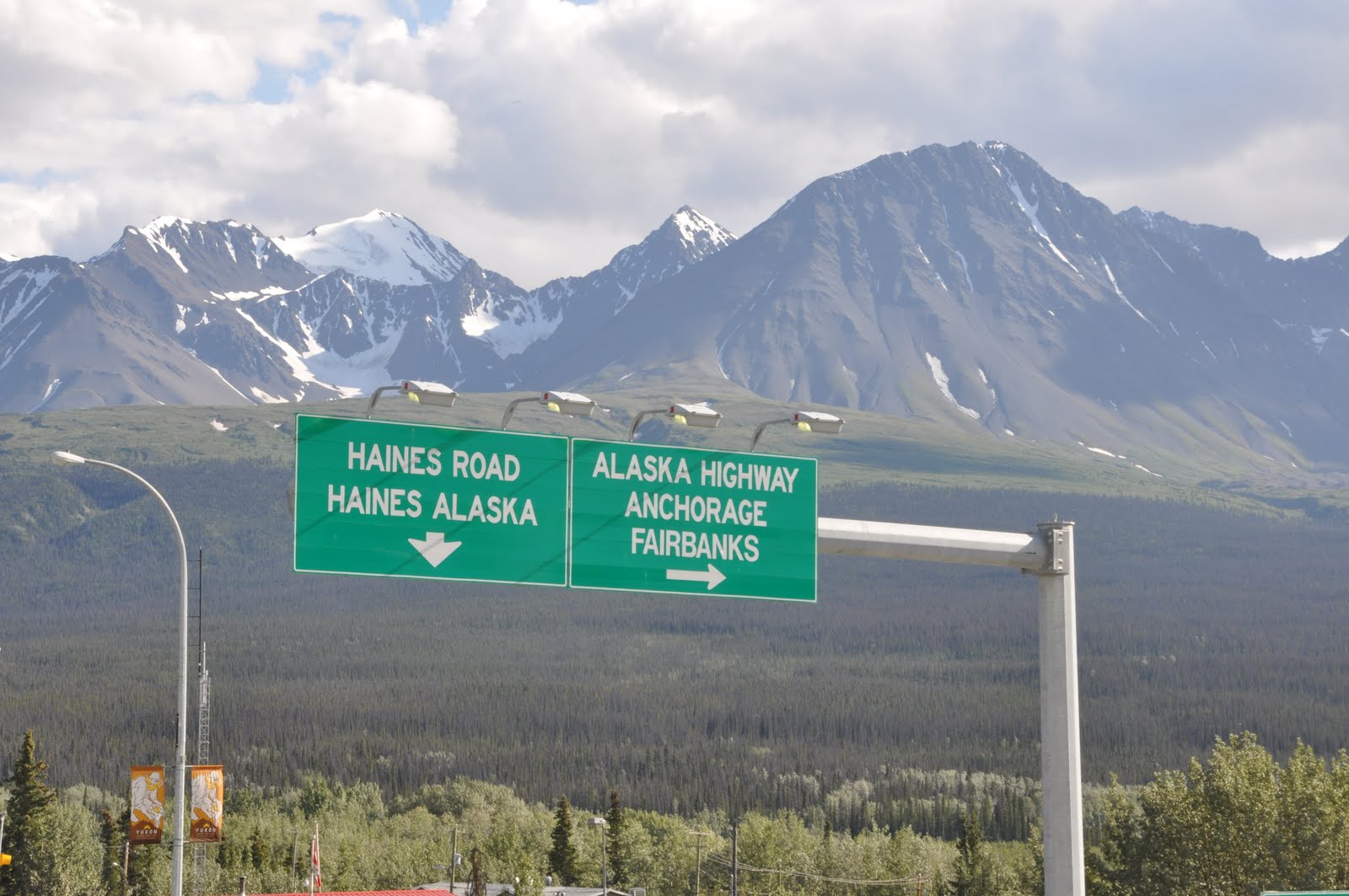
As we approached Muncho Lake we saw more wildlife than on any other day of our trip. We got a good soak in at nearby Liard Hot Springs. At Haines Junction we stopped at one of the good bakeries there for coffee and wifi. Getting back on to the highway we missed what is possibly the largest, least subtle junction road sign in all of North America.

We began to suspect something was wrong when we re-entered British Columbia, since our next border should have been customs at Port Alcan. Well, Richard began to suspect something was wrong. Still drowsy, I espoused the theory that British Columbia had just put up the sign in the wrong place. About 45 minutes from Haines Junction we were stopped by a flagman (woman) to wait for a pilot car to lead us through the construction zone. In a land where there are only a few short months to improve the roads and correct for the roller-coaster-like frost heave, we found ourselves waiting for pilot cars a number of times. Richard got out and asked:

“Is this the road to Haines?”

We did not want to go to Haines. The woman confirmed his suspicion and laughed, not unkindly, knowing how long we had come out of our way.

On our last day of travel, more than 4,300 miles from our start, a hazard light on the dashboard warned of a flat tire. We were in the final stretch, on a dirt and gravel road 20 miles from a B&B that ostensibly offered tire services and free coffee. A visual inspection showed nothing amiss, so we decided to go on 10 more miles and check again. Sure enough, my left rear tire had lost its characteristic firm, round quality. We felt every rock and bump in the road acutely as the Forester limped the final 10 miles.

We drove up the steep dirt driveway of the B&B. A man with a gray beard looked handy, standing as he was on a ladder nailing tarpaper onto some sort of extension to the main house.

“We seem to have a flat tire,” I told him.

“You’ll need to talk to Jennifer” he said, motioning toward the lodge-like house.

I found Jennifer at work in the kitchen. She offered coffee, and we accepted. Jennifer conferred with the man on the ladder, who confessed to being less handy than he looked. As he and I were similarly useless in this situation, we passed the time chatting about his real passion: bow-hunting. He was working for his room and board in order to be able to stay in this caribou and caribou-hunter’s paradise.

Jennifer emerged from the house with a young man in his early 20’s; Benedict said he had fixed three or four tires in his life. That was more than the rest of us combined, so he got the job. It took a while to unload the car sufficiently to get to the jack and spare. Richard positioned the jack, and Benedict took over from there. A rock emerged from the tire; it was the shape of a nail but considerably thicker. Benedict patched the tire, and the three men decided to put a lot more air than was called for, “just to be safe.”

“What do I owe you?” I asked Benedict. He shrugged and sent me back to Jennifer.

“Whatever it’s worth to you,” Jennifer told me. “Just pay the kid.”

Whatever it’s worth to me? That was not the answer I was looking for. I was less than 40 miles from my destination, the cabin where Gary was waiting for me. We had emailed ahead a few hours earlier and told him we’d be there for dinner. The going rate for the tire fix? Probably twenty dollars. What did I pay? Sixty dollars. What was it worth to me? Priceless.

When we got to the cabin, Ella found us first. She wriggled and wagged and talked and leapt. Her paws on my shoulders, she hugged me and kissed me copiously. Who knows where her mouth had been, and who cares? This language we share, and after almost three months apart we had a lot to say to each other.

With Ella about, I knew Gary couldn’t be far, but we waited for an endless moment, Richard, Ella and I, in front of the cabin.  And then he emerged.

In Deep

Oh, so you heard! Yes, I’m moving to Alaska. Yes, I am sure. No, I can’t really work from there. I did hear something about the winters, yeah.

No, I don’t suppose I do know what I’m in for, but I am really excited. Did you see the pictures on Google Earth? It’s so beautiful. The creek runs through the property, the Alaska Range is right there, just stunning, and the tundra! It’s beautiful too, but what I really love is how squishy it is.

I should be there just in time for blueberry season, and Gary’s started a summer garden with chard and kale and cabbage, though I guess something ate all but two of the cabbages. We’ll hike and run and ski and snowshoe; I’ve never gone snowshoeing before, and I’ve never seen the northern lights! I’ll have lots of time to read and write and learn to weave and use my camera. We’ll see all kinds of wildlife. Porcupines live under the cabin—the other day Gary almost stepped on one on the porch, barefoot. I’ll be cutting wood and carrying water, and I’ll get to fish for our dinner!

We’re between Fairbanks and Anchorage, but off the main highway quite a ways. The Costco’s in Anchorage, and that’s four or five hours away. Except in winter, when our road is closed and we’ll park in town and take the snow machine to get to the car, which I guess adds an hour or two. Right, snowmobile, but for some reason they say snow machine. Gary keeps warning me that I’ll miss my fresh veggies in the winter, because even if you can buy them they freeze on the way home.

Well, the town there has a couple of gas stations and a Laundromat, but I think for real shopping we’ll have to drive from there. Oh, and there’s a vet, but no doctor.

It’s a cabin—a few hundred square feet I guess, with a loft for the bedroom.  I did see it once a long time ago, but I don’t remember it well. There is solar, and I think he’s working on adding wind, seeing as how there’s not a lot of solar in winter. Hmmmm…does the creek count as running water? He’s building me a shower—you heat water on the wood stove, run it upstairs, pour it in, and run back down to a hot five-gallon shower!

No, I’m not crazy about outhouses either, but I suppose I’ll get used to using one.  Yes, there are bears, but Ella’s a good guard dog. She usually gets a biscuit if she goes with you to the outhouse—Gary says that’s why she was always right there with me in the bathroom when they were living here.

There’s no cell service, but we did just get satellite Internet so we might be able to Skype. Anyway, I’m starting this blog to stay in touch. I’m calling it In Deep (Alaska):  I’m in love, I’m committed, I’m in deep. And I don’t know where this will take me, but for now I’ll be in deep Alaska.