• Backstory
  • Glossary of Alaskan Terms

indeepalaska

indeepalaska

Tag Archives: Alaska off-grid living

Small Victories

10 Friday Feb 2012

Posted by Barbara in Daily Life

≈ 7 Comments

Tags

Alaska off-grid living, Glossary of Alaska Terms, woodstove baking

I once read that happiness in life is most often found among those who continually take on challenges, challenges small enough to make success achievable but not so small as to ensure it. Researchers found that happy people stretch themselves, maybe just a little, but often. Meeting the tests successfully more often than not, their sense of achievement, self-determination and self-assurance grows, and this seems to lead to happiness.

Work of any definition can be fertile ground for pursuing happiness through challenge. I was lucky to have mentors in my career who fed me a steady diet of challenges I could (with their support) manage successfully often enough to get beyond my failings and not infrequent failures. My challenges now are, arguably, much smaller; they are surer of success, and in success or failure negligible in their impact on others. In a recent post (www.indeep-alaska.com/2012/01/30/division-of-labor-2) I mentioned a few: learning to build a fire, drive a snowmachine, stack wood, and can berries.

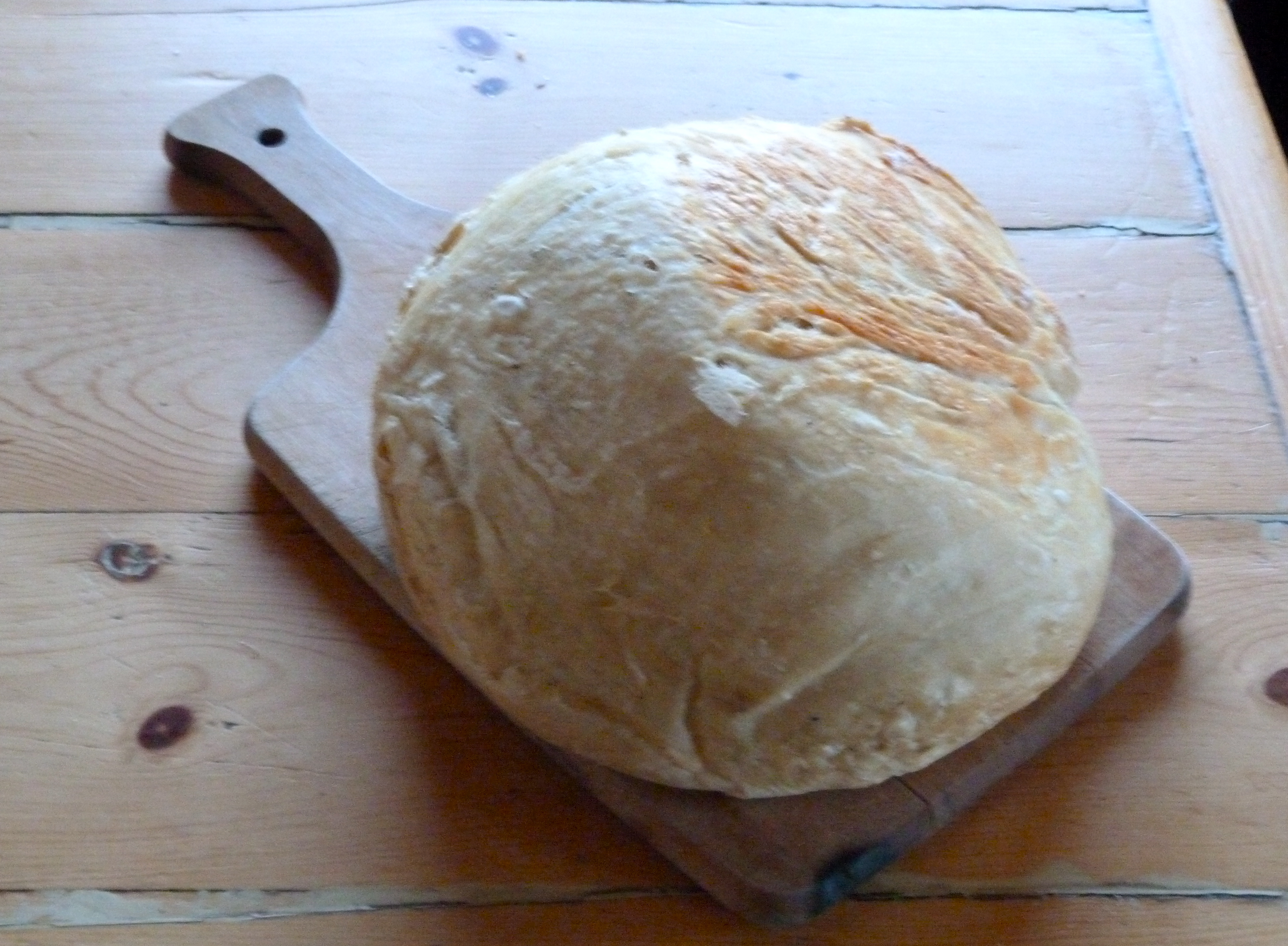
My second attempt at woodstove yeast bread, a little oddly shaped as I had to flip it over to brown the top.

I’ve been learning to bake atop our wood stove. With varying degrees of success I’ve made pumpkin and cranberry-orange quickbreads, chocolate chip cookies, brownies, sweet potato biscuits and lasagna. I finally conquered my long-standing fear of baking with yeast by attempting French bread. The first loaf was heavy and dense, successful mainly as a butter-delivery system and because it had been ever so long since we’d had bread. But the second loaf and all that followed were really good, excellent even. The big surprise was how easy it is, yet it took so long for me to try. (It’s so easy, in fact, I was making a loaf a day in hopes of freezing a supply, but had to stop. We were eating most of it hot off the stove, a daily feast of refined grain slathered in butter.)

Homeward bound, looking upriver as we return from logging

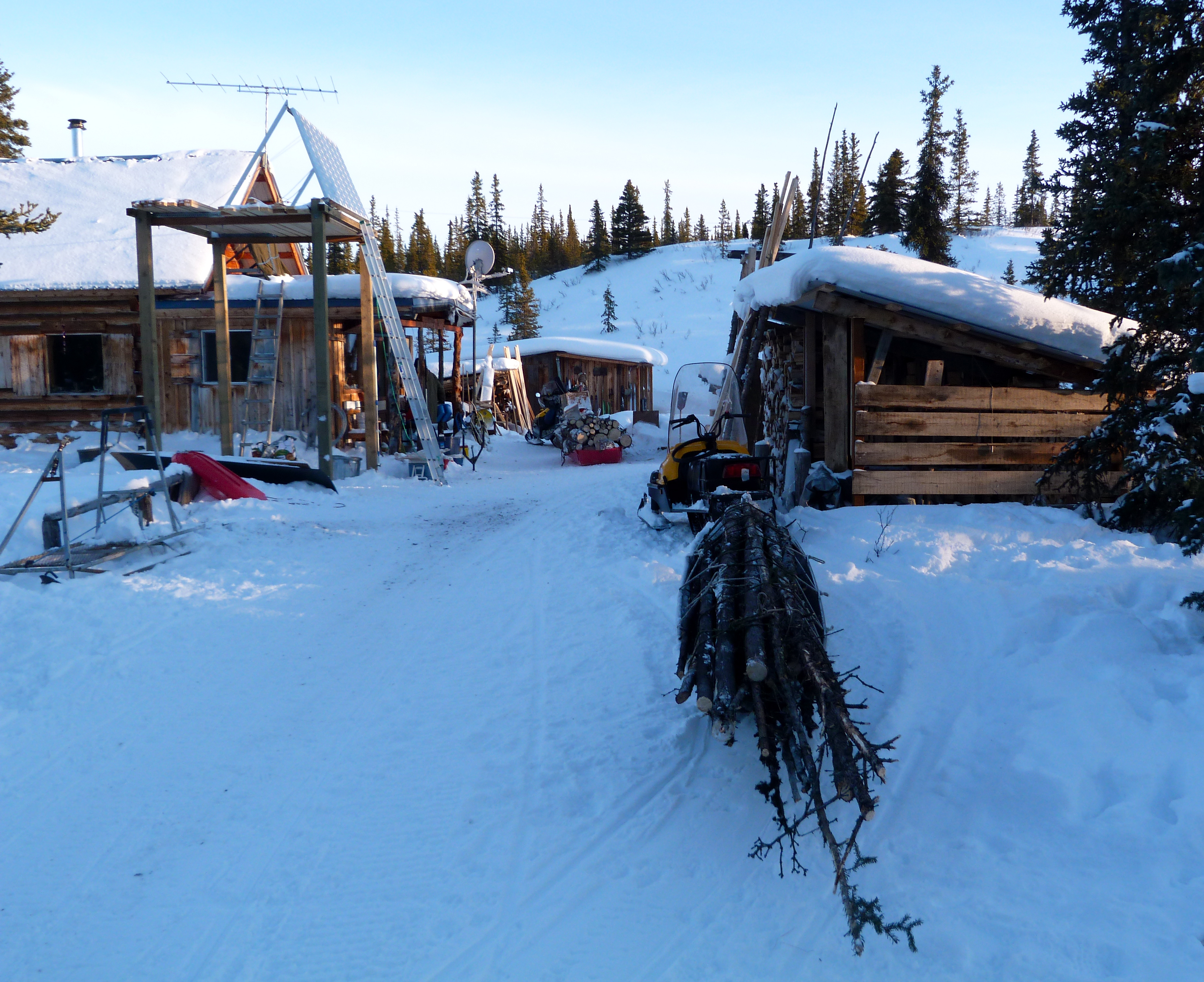
This week I’ve been learning to tie knots, and was pleased with myself all out of proportion when I used a bowline knot to secure my snowshoes (I wasn’t wearing them!) to the sled I was hauling behind the snowmachine. That was another first: as Gary led the way downriver to the woods to do some logging, I followed in his old snowmachine, smaller and less stable than our new one. I’d never driven it before — never driven on river ice either, for that matter — and Gary had warned me the machine tips easily. So I declined to try when he suggested it last week. When he mentioned it again yesterday, I felt ready. Snowmachines have seats; at least they look like seats and feel like seats, but God forbid you actually sit down. I had to stand or put one knee on the seat in order to shift my weight quickly enough to stay upright through uneven snowdrifts and curves. On the return trip I carried a sled full of skinny logs we’ll use as poles, which Gary had carefully tied down. Good thing he did: I was so focused on the path ahead, the whole load could have slipped off and I wouldn’t have noticed. It didn’t, of course, and we all got home without incident. It’s a victory of modest measure, but satisfying still.

Home from logging with both snowmachines

In my past life, when free time was in short supply and home life unhappy, I found it difficult to extend myself. Baking a loaf of bread seemed too much to attempt. I did take up running, a fair challenge. But that was nearly twenty years ago, and it’s no coincidence I wasn’t working at the time.

I’m proud of friends and family whose work touches lives, directly or indirectly, and in so doing contributes importantly to the larger world. It isn’t only by comparison that my victories here are small, their impact isolated. But these little victories change me. One at a time they broaden my understanding of the possible, bring me joy and renewal, and ready me for challenges — great and small — that lie ahead.

Spruce grouse in a spruce tree in our yard

Sunrise:  9:06 a.m.
Sunset:  5:14 p.m.
Weather: High 32°, low 24°, breezy with occasional snow.

NOTE: I’ve added a glossary of Alaskan terms to the website as a separate page at www.indeep-alaska.com/glossary-of-alaskan-terms/. Enjoy!

Three days to Thanksgiving

16 Friday Dec 2011

Posted by Barbara in Travel

≈ 9 Comments

Tags

Alaska off-grid living, Alaska snowmachine, Alaska winter travel, Denali Highway

By the Tuesday before Thanksgiving, we still hadn’t told Gary’s sister Karen whether we would come. An email from her daughter, Kristen, saying “please please please” promised cheesecake and “maybe” a lemon meringue pie. Our desire to go had been sincere, but now we could taste it.

But our failure to confirm didn’t stem from ambivalence, forgetfulness, laziness, lack of courtesy, or even—my personal favorite—lack of wind power. It was just too cold. Nights dropped to 36 degrees below zero, then 38 below; if temperatures didn’t rise during the day, the wind did.
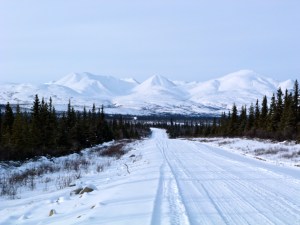
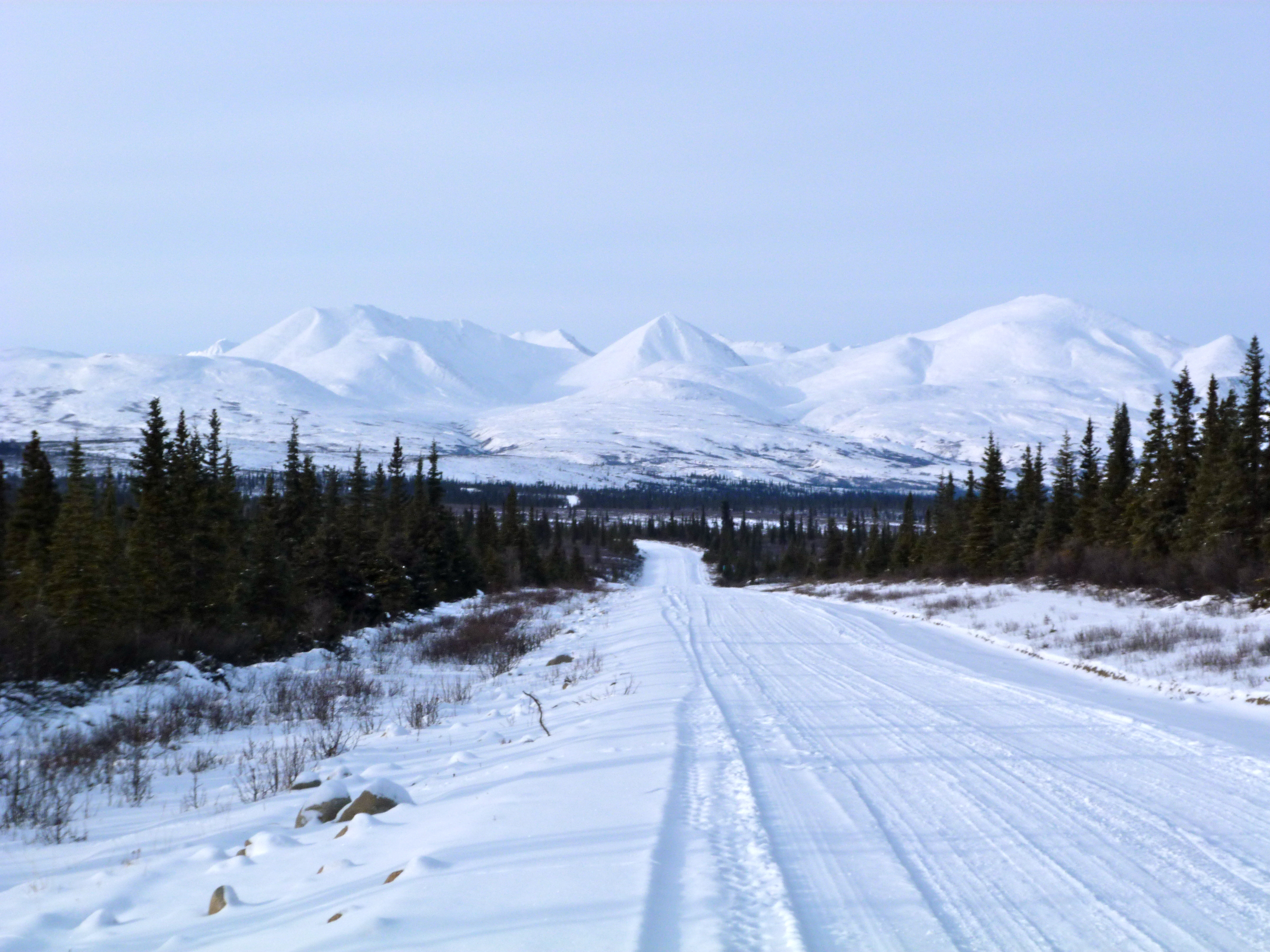
On the "highway" going to town

So, without a break in the weather, Thanksgiving travel was a non-starter. Literally. We were pretty sure my car wouldn’t start, and dead certain when even the snowmachine balked.

“This is not good,” Gary said. Ella hates swearing, so Gary has developed a gift for understatement.

My car is parked in town, thirty miles away and more than an hour’s travel by snowmachine. It’s not a trip we’d voluntarily make in those temperatures; it’s dangerous in extreme cold to be sitting still, let alone on a machine that creates its own wind chill. But without a snowmachine, we’re truly stranded. In an emergency, we would have to email friends to call one of the local bush pilots, or go out to the road hoping to flag down a passing musher.

The day warmed, the snowmachine started, and we found new energy to prepare for the trip. Our cabin and everything in it would freeze once we left, so we had to deal with anything that wouldn’t survive and ready things to return the cabin to its toasty state quickly when we got back.

On Monday we’d taken care of everything that wasn’t time-sensitive. Some things were basic: changing the bed, gathering six weeks of laundry, tidying, making shopping lists, packing. Gary built a wooden box for Ella to ride in behind the passenger seat. On Tuesday we did the things we’d wish we hadn’t if we did end up staying home: we put away tools, skis, snowshoes, and anything that might walk away (snowmachiners sometimes explore the area) or disappear under a snowfall. Gary began packing the sled with the space heater and battery charger for my car, gas containers to be filled, and coolers to fill with groceries for the return trip. He split birch wood into kindling to start a very hot fire very quickly when we got back. We gathered sleeping bags, fire starter, flashlights, and extra warm clothes in case we broke down on the road.

I focused on food. We had two enormous bags of carrots, several pounds of sweet potatoes, purple potatoes Gary and Karen had cultivated in their mother’s garden during the summer, a couple of onions, a bag of garlic, and a flat of apples, none of which take well to freezing. I must have spent an hour grating carrots, missing my Cuisinart for the first time. When I couldn’t stand grating anymore, I mixed the grated carrots with crushed pineapple and raisins for a salad to take as our contribution to Thanksgiving dinner. The rest of the carrots I blanched in stew-sized chunks, so they would still be sufficiently carrot-like for cooking when we got back. I blanched the purple potatoes, too, and Gary baked the sweet potatoes atop the wood stove in the Dutch oven. The salad and the rest of the perishables he wrapped in a sleeping bag and set in a cooler to make the round trip.

I emptied the water filter for fear its ceramic elements might otherwise crack if they froze. Ella packed her food and dishes—well, someone did, anyway. When we went to bed late Tuesday night, the temperature was eighteen below. Not bad. We were almost ready to go.

Wednesday morning we woke early. Now it was twenty-eight below, pretty close to some unspoken cut-off point. We ate quickly and downed our coffee. We gathered bowls and buckets and pans, pouring in only a couple of inches of water in each; that way the ice wouldn’t warp the containers and it would thaw quickly when we got back. Gary finished packing the sled and carefully tied it all down while I finished dressing.
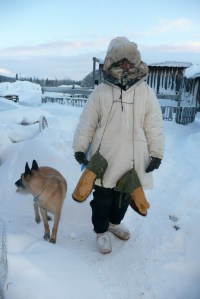
Arriving at Diane's, where my car is parked

I wore two pairs of long underwear, three pairs of socks, mukluks with two insoles—tufts of hair Ella had been shedding sandwiched between them—a pair of wind-resistant pants, and down over-pants. Then came a wool camisole, a silk turtleneck, a cashmere turtleneck, a Swedish wool zip turtleneck with a long shirttail (sweatertail?) and thumbholes—great for eliminating the gap between mittens and sleeves—and a wool plaid shirt. I waited until I was outside to don the giant hooded synthetic down parka—sold to us with the understanding that it would be uncomfortable in temperatures above zero—a neoprene ski mask, goggles, and a wool hat. I topped all this with a windproof, canvas, knee-length hooded anorak with a thick coyote ruff. Only then could I cover my cashmere-lined leather gloves with bulky wool knit mittens, which went inside gigantic over-mittens.

You may be wondering how I could move or breathe.

I couldn’t.

Ella and I walked to the road while Gary warmed up the snowmachine. I thought he would stop to lock the gate, so I took off my hood and goggles; since I couldn’t do anything with my mittens on, they came off, too. However, as it happened, Gary had no intention of taking time to lock the gate; he had the same problems with movement and overheating—it’s as much a matter of safety as comfort to avoid getting wet with sweat in that weather—and was none too happy about waiting while I struggled to get my mittens and goggles back on.

I faced backward on the snowmachine for two reasons: to reduce the wind in my face, and to watch and comfort Ella, who is happy to run alongside and then catch a ride in our arms when she tires, but did not want to ride in a box. I stuffed my overly mittened hands into the box next to Ella’s warmth, peering at the passing landscape from beneath my fogged-up goggles. Gary reached back and gave me a reassuring pat on the leg.

After several miles he pulled to the side and stopped. I tried to turn toward him, but only a few of my layers turned with me, so I couldn’t see him. All those hats and hoods create a pretty convincing preview of what my hearing will be like if I live long enough, so when I heard Gary’s voice I assumed he was saying, “A musher’s headed this way,” or “I have to pee.”

But he wasn’t. Frustrated, he shouted, “Look!” and pointed.

I managed to turn enough to see a gorgeous bull caribou in his winter-white cape.

“What did you think I was stopping for?” Gary said, more quietly now that he had my attention.

“No idea,” I said. Even more than a few words seemed difficult with all the layers.

The next time we stopped, I worked harder to get both myself and my clothes to face forward. Good thing, too: Gary wanted to show me a gorgeous view of the Mountain. Here, “the Mountain” refers to Mt. McKinley─Denali. It’s the same as San Franciscans saying “the City” when speaking of their town. It would have taken too long for us to dismount and get back on, so I handed Gary my camera.

If I have your address, you will probably get our holiday card with the photo Gary took that day.
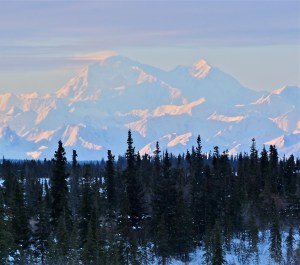
View of Denali on our way to town

Less than ten miles later we reached my car. The battery was dead. Even the heater─the one we had brought to heat the engine─wouldn’t start until we thawed it in our friend Diane’s home. I hoped what I saw dripping as Gary carried the heater back to the car was melting ice, but when Diane stepped back inside from feeding her goats, she found me sniffing her floor.

“Uh, we dripped fuel oil on your floor,” I said awkwardly. Confession seemed like the only option.

“That’s OK. Are you kidding? It’s not the first time,” Diane reassured me cheerfully.

Then she pointed out the outhouse, seemingly apropos of nothing. I looked out the window and realized she would have had a perfect view of me peeing out front when we first arrived.

“Oh, great, thanks!” I answered weakly, deciding against confession this time.

A couple of hours work got the battery charged. Gary had transferred everything from the sled to the car, and we were ready to go again, except now the Subaru’s back gate didn’t want to shut tight, leaving us with the interior lights on. Dark was closing in, and we had several hours of driving on snowy roads ahead of us. We unscrewed the bulbs we could reach and drove on. After a while we pulled over, and by then the tailgate was more cooperative.  Soon we were able to get a radio station to come in. A reporter stated that 42 million Americans were traveling over the holiday weekend, most by car. We saw about 42 of them in the first couple of hours of driving.

When we finally pulled in to Karen’s drive it was well after the dinner hour, but we found a warm welcome, pizza, a microwave, and a shower. It wasn’t Thanksgiving yet, but we were very thankful.

Sunrise: 10:32 a.m.
Sunset:  3:09 p.m.
Weather: High 17, Low 7, snow and wind.

Note: In the hustle of the return trip, I lost my camera and the photos for this posting.  When I come up with similar ones, I’ll add them.
The Fog of Winter

10 Thursday Nov 2011

Posted by Barbara in Uncategorized

≈ 3 Comments

Tags

Alaska off-grid living, Alaska winter, life in Alaska, off-grid

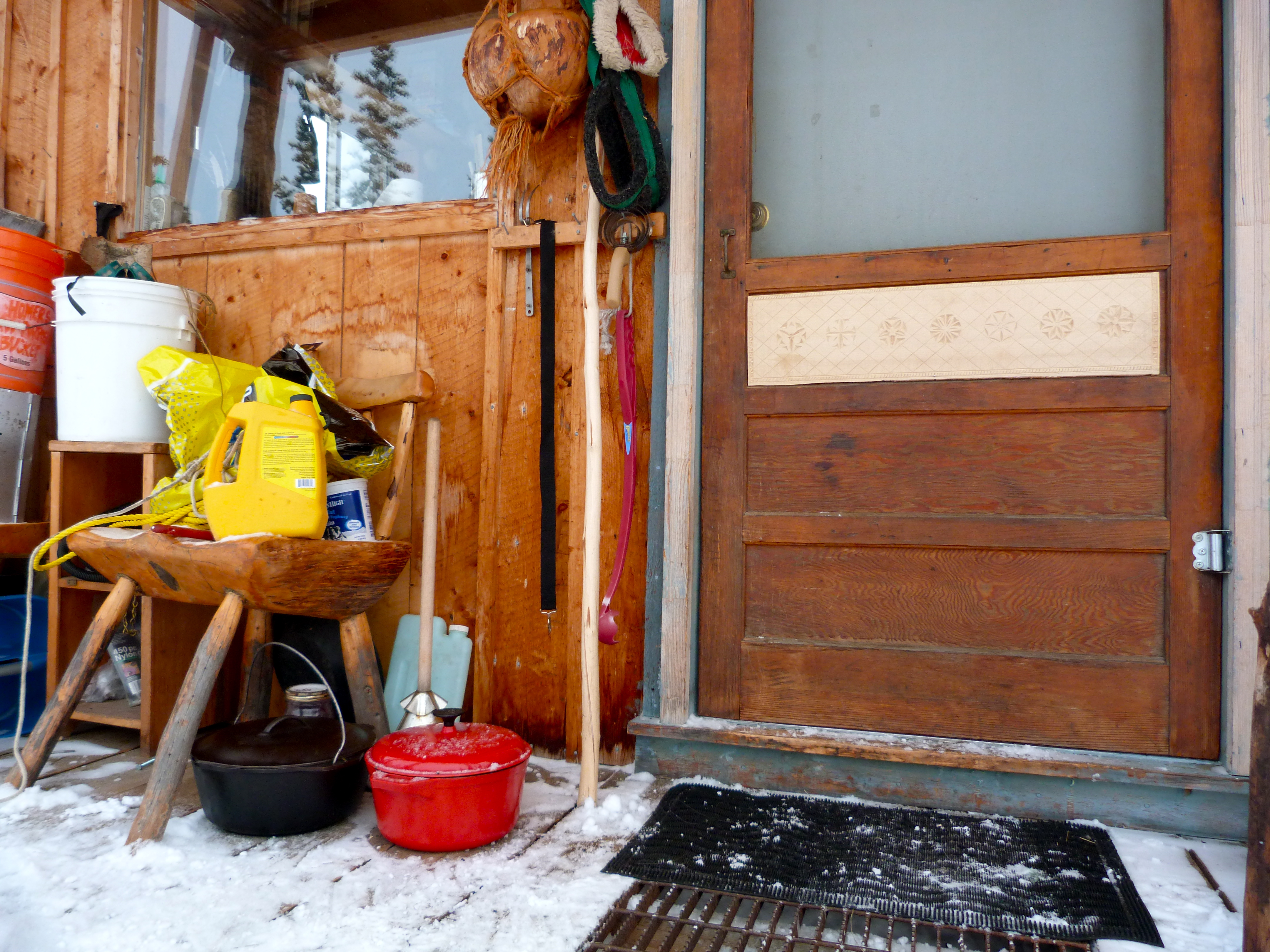
I leaned out the door and snatched the cast-iron Dutch oven from its spot under the chair on the porch. The chair is little-used since the weather turned, but the porch has taken on a new life as our freezer, large enough to hold cheese, cream, chickens and other supplies for the coming months as well as leftovers still in the pot, waiting to be reheated. With a fleet kick I slammed the door shut, but not before a fog had pervaded the kitchen. Fog, yes, but nothing like the wrap that envelops San Francisco, protecting it from extremes – extremes of temperature, anyway. It reminded me of the fog from a commercial freezer. My hand stuck to the knob, just for a second, as I went out again to check the thermometer. Ten below zero.

Dutch ovens in the "freezer"

November is still new; the calendar claims we’re little more than halfway through fall. But if winter isn’t on-scene yet, clearly the stage is set.

I wouldn’t have said that a few days ago. The temperatures had been running in the teens, but, despite a wintry backdrop with a delicate snow cover, the days were crisply autumnal. Still, now, all I need to do to stay warm is dress properly, stay active, and keep the fire going. It’s been gorgeous weather, really. Sunny days are the cold ones now, but they show off the mountains best and tempt us to make time to hike or ski. Cloudy days tend to be warmer, and bring the most beautiful sunsets. Snowy days cover our footprints and make everything clean again.  But I get the impression that a number of my friends in San Francisco agree with my friend and former colleague Steve, who says he would catch the first moose out of here.

Though I find myself startled by the stark shift, it is part of an evolution that has been playing out for weeks and is far from complete. A week or two ago we decided it was safe to turn off the propane refrigerator/freezer so we could close the kitchen windows, which were cracked open to prevent carbon monoxide buildup. With little chance of a thaw now, we can count on the floor space near the door to stay at refrigerator-like temperatures, at least until the nights grow even colder.

The creek changes daily. Ice formed along the shore first, then built up from the creek bed mid-stream. Just as I was gaining confidence that the icy shoreline would hold me while I filled my buckets, I came out one morning to find an overflow of water forced up by the expanding ice left me no choice but to wade in several inches of slush to dip my ladle. This made it harder to know how far I was from shore and how solid the under-slush ice was.  When I got back to the cabin with the water, I fretted aloud about falling in.

I'm ladling water among the willows, which used to be onshore!

Gary was reassuring. “Don’t worry,” he said. “It’s not deep.”

Whereas the ice may or may not be strong enough to hold me, some days it is thick, so I bring a shovel along in case I need to punch through to the water underneath. Lately, though, the overflow has flooded the banks, so the slush I find myself in is in the willow brush.  Gary’s right: it’s not deep.

The sled makes hauling water from the creek easy

I’ve been surprised to see how winter can make things easier. I would much rather pull my heavy buckets on a sled than carry them or push them along in the wheelbarrow. Hauling almost anything, in fact, is easier with the sleds, pulled by hand or snow machine. Cooking is simpler, too; the wood stove is a perfect slow-cooker and warming burner. I have a chicken in the pot as I write, and just hope I remember to pull out the giblets once the bird has thawed enough for me to get at them. The two big stockpots of water on the stove heat quickly and stay warm all day. And with the freezer empty, I have way more storage for pots and pans.

Now we have extra space for pots and pans

Some things, predictably, are harder in winter. But the mattress? We have a Tempur-Pedic—you know, the kind that sort of reshapes itself around you. My side of the bed is next to the window. Though we close the window each morning—the loft can get hot, so we do like the fresh air at night—through some sort of operator error it was left open one cold, windy day. When I went to bed I found that the mattress had, well, solidified. After five or ten minutes it started to yield a bit, so I got comfortable and reached for my water bottle. It was frozen, too.

Getting dressed is a challenge. It’s not just the magnitude of the task—underwear, knee socks, long underwear top and bottom, wool crew socks, pants and top, maybe another top or sweater or two, jacket, boots, hat, hood, glove liners, gloves, and, for some occasions, down over-pants (for cold) or canvas over-pants (for wind and wet snow), anorak, knee-high snow gaiters, mittens, over-mittens and ski mask—but the task of remembering to put things on in the right order. This morning I got all my socks and long underwear on before remembering my regular underwear.  I had to start over. And I’m trying to learn to time it so I don’t go mad in the heat of our toasty cabin with all those layers on.  Once I’m dressed, I’m out. Oops, I forgot my sunglasses.

I’ve been here almost three months. Other than the cold, rainy day when we finally got the wind turbine up and working, I can’t think of a single day that I’ve wanted to stay indoors. At first I waited expectantly for the weather to invite us to spend all day reading by the fire, sipping hot chocolate. Those days may yet come in abundance. But so far it’s been one long stretch of beautiful days, fresh and lovely outside, cozy inside.

Ella enjoys the view on a hike upstream

I had always thought of good weather as sunny, mild days, or beach weather, or the crisp clear days of autumn. What I used to see as bad weather was generally just bad for whatever I happened to be doing or wearing. I’m no longer commuting or having to walk through rain or salty slush in my good work clothes, and I’ve never had to bundle up small children for cold weather. I am learning what to wear depending on conditions and what I’ll be doing. And I’m discovering that beautiful weather can be many things.

“It’s only ten below,” Gary reminds me. “Wait until it’s forty below.”

I can’t wait.

Sunrise: 9:00 a.m.
Sunset:  4:19 p.m.

Weather: High 21, low -4, cloudy with some light snow last night. Early Wednesday morning the temperature dropped to -28!

most recent

  • Groundbreaking News!
  • The Adventure of a Lifetime
  • Spring Showers
  • The Death of Winter
  • Here Comes the Sundog (to Blue Moon Stead)

Categories

  • Adventure
  • Background
  • Daily Life
  • Food and Hospitality
  • Nature
  • Sights and Surprises
  • Travel
  • Uncategorized

Archives

  • August 2021
  • November 2015
  • March 2015
  • December 2014
  • November 2014
  • June 2014
  • March 2014
  • November 2013
  • February 2013
  • December 2012
  • November 2012
  • August 2012
  • July 2012
  • June 2012
  • May 2012
  • April 2012
  • March 2012
  • February 2012
  • January 2012
  • December 2011
  • November 2011
  • October 2011
  • September 2011
  • June 2011
Creative Commons License
indeep-alaska.com by Barbara Bailey is licensed under a Creative Commons Attribution-NonCommercial-NoDerivs 3.0 Unported License.

thanks

Thank you for your visit and your support. I hope you enjoy my adventures as much as (or more than) I do!

Enter your email address to subscribe to this blog and receive notifications of new posts by email.

Join 147 other subscribers

RSS subscribe by rss

  • Groundbreaking News!
  • The Adventure of a Lifetime
  • Spring Showers
  • The Death of Winter
  • Here Comes the Sundog (to Blue Moon Stead)
  • Lucky
  • More news from Blue Moon Stead
  • News from Blue Moon Stead
  • Searching In Deep
  • Christmas Gifts
In Deep (Alaska) logo

Blog at WordPress.com.

  • Subscribe Subscribed
    • indeepalaska
    • Join 54 other subscribers
    • Already have a WordPress.com account? Log in now.
    • indeepalaska
    • Subscribe Subscribed
    • Sign up
    • Log in
    • Report this content
    • View site in Reader
    • Manage subscriptions
    • Collapse this bar
 

Loading Comments...