A Solstice Wedding

We knew my cousin Glenn was getting married, but he had talked of a courthouse ceremony. His seventeen-year-old daughter, Danielle, was having none of it and began planning a small but lovely event in Anchorage’s Hotel Captain Cook on the winter solstice. Glenn sent us an email not quite two weeks in advance, asking if we could come. Then, a week later, another email came from Glenn and his lovely bride, Terri, asking Gary to be the best man. We consulted Danielle about the dress code, via Glenn’s sister Joan, since we don’t text.

“Gary should wear a suit, and Barbara should wear a dress,” the answer came back.

This triggered a frantic search through the cabin, outbuildings, and even Glenn’s cabin next door—anywhere we might have stored clothes.

“Don’t laugh,” Gary said, coming down from the loft in one of his father’s old suits.

His arms dangled from the sleeves, but the pants looked hot—and very likely to rip. He modeled two more suits, of unknown origin, each worse in its own way. The final option was an “Alaskan Tuxedo,” a sort of arctic safari suit made of good, heavy wool in Austrian green. Gary had bought it for his oral exam to become a licensed game guide, circa 1986. The Alaskan Tuxedo (not this particular one) dates back to the 1920’s, and it does have a strong, authentic look. Sadly, the style appears to have inspired the leisure suit. Another no-go.

I had it easy, or so I thought. My brother, Richard, and I had attended a party the night before we set out on our drive to Alaska (see “Driving Miss Lazy,” September, 2011). I wore a simple black dress with a turquoise-and-gold scarf my friend Savi had brought me from India. An extensive search turned up only the scarf. No dress, no hose, no shoes. The only other dress I had was sleeveless and on the slinky side. I’d brought it in case Gary and I wanted to dance all alone in our cabin, not realizing our only potential dance floor is a three-foot by five-foot space dangerously close to the wood stove.

Clearly we would need enough time in Anchorage to shop before the wedding.

When we went to Anchorage in mid-October to pick up our snowmachine, we didn’t know when we would next be in that shopping mecca. Anchorage is no San Francisco, but it is home to some 300,000 people, two Costcos, a natural food store, a cheese shop, and an upscale deli/grocery offering a surprising assortment of ethnic cuisines and ingredients. It has the usual big box stores, too, Nordstrom, gun shops that aren’t even in bad neighborhoods, and some eccentric specialty shops with clothing, hardware, and sundries for people who live, work, or vacation on boats or in the bush. We shopped at many of these stores on our last trip, doing our best to bring back everything we thought we might need if we didn’t leave home again for months. As it happens, we’ve been back twice since, once to spend Thanksgiving with Gary’s sister and her family, and this time for Glenn’s wedding.

But first, Gary and I spent the weekend before the Wednesday ceremony preparing for the freeze-up of the cabin, much as we had at Thanksgiving. As soon as we heard about the wedding, we worked to eat as much as we could of the fresh produce that we didn’t want to freeze.  We incorporated fresh carrots, sweet potatoes, and onions into our daily diet, and we each got a whole banana on our daily oatmeal instead of half. Oranges became more than a snack: we dried the peel atop the wood stove for kindling. I cooked up some onions for future French onion soup, but the remaining produce—apples, garlic, and more carrots than I wanted to cook—would travel with us to Anchorage and back in a cooler wrapped in a sleeping bag within a cooler to prevent it from freezing on the snowmachine leg of the trip.

Instead of putting an inch or two of water in our various pots and pans (see “Three Days to Thanksgiving,” December, 2011), this time we made ice in cake pans all weekend, thinking it might be easier to thaw. Good idea; bad timing. The day before we left, a Chinook wind warmed temperatures so close to freezing we almost couldn’t make ice. But I managed to fill a bucket and a couple of stock pots, and it was, in the end, more convenient when we got home.

Gary finishes packing the sled; Ella is dressed and ready to go

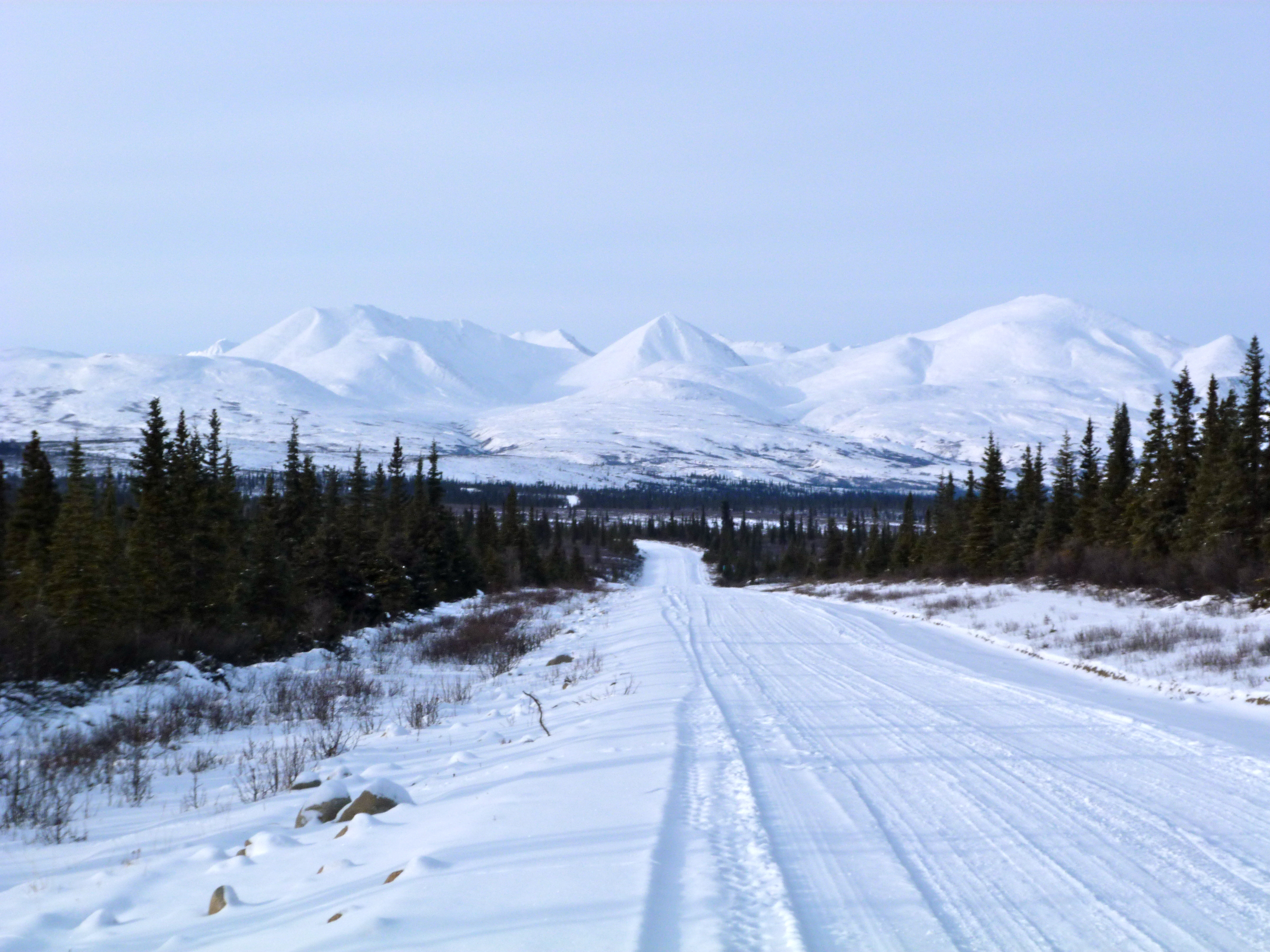
We left the cabin Monday just before sunrise—which is to say, a little after 10:00. The warmer temperatures inspired another innovation: instead of riding backward on the snowmachine as I had been doing, facing Ella in her box with my back to the wind, I rode facing forward, reaching back to put my arm around Ella’s neck. Ella seemed calmer, and it was much more comfortable for me. I loved being able to see the Mountain, the moose, and the mileposts. I tried the driver’s seat briefly, but carrying two passengers and a sled made me too nervous to enjoy it.

The car battery was dead when we arrived at our friend Diane’s, where it’s parked, but we were expecting that. From Diane’s, travel was easy, and we made it to Glenn’s in time for dinner at 6:30.

We devoted Tuesday to clothes shopping. (I’d brought my one dress, and Gary had brought his Alaskan Tuxedo, just in case.) We had no luck as Gary dragged me around Value Village and Saly’s (Salvation Army), his preferred clothing recyclers, so we enlisted Terri and Joan, who made short work of the problem. No one had ever seen Gary in a suit but he often wears a vest, so Joan suggested one now. For me they thought a wrap would ameliorate the defects of the sleeveless slinky dress, and Gary quickly spotted an earth-tone knit shrug as we headed out of Penney’s on our way to Nordstrom. Making our way through the mall we ran into Payless Shoes where I found something for ten percent of what I was willing to pay if only I could see the inside of the Nordstrom. But once I bought the shoes we were fully outfitted, so I never got there. My idea of a bargain used to be forty percent off at the semi-annual Armani sale. I’m learning skills now that go way beyond the wilderness.

Gary in his three-piece suit and me in my slinky sleeveless dress, disguised.

I’m old enough to feel a sort of surprised relief when reuniting with friends and family is an occasion of joy and not sorrow. Gary is like a brother to Glenn and Joan, and this gathering gave me a chance to meet a few of their childhood friends. I listened to stories from long before I had met Gary or my Alaskan cousins, and got to see for myself how well-loved Gary is by those who have known him longest. The wedding was intimate and low-key, a delight. And there is no truth to the rumor that I made a flying leap to catch the bouquet. It fell right into my hands.
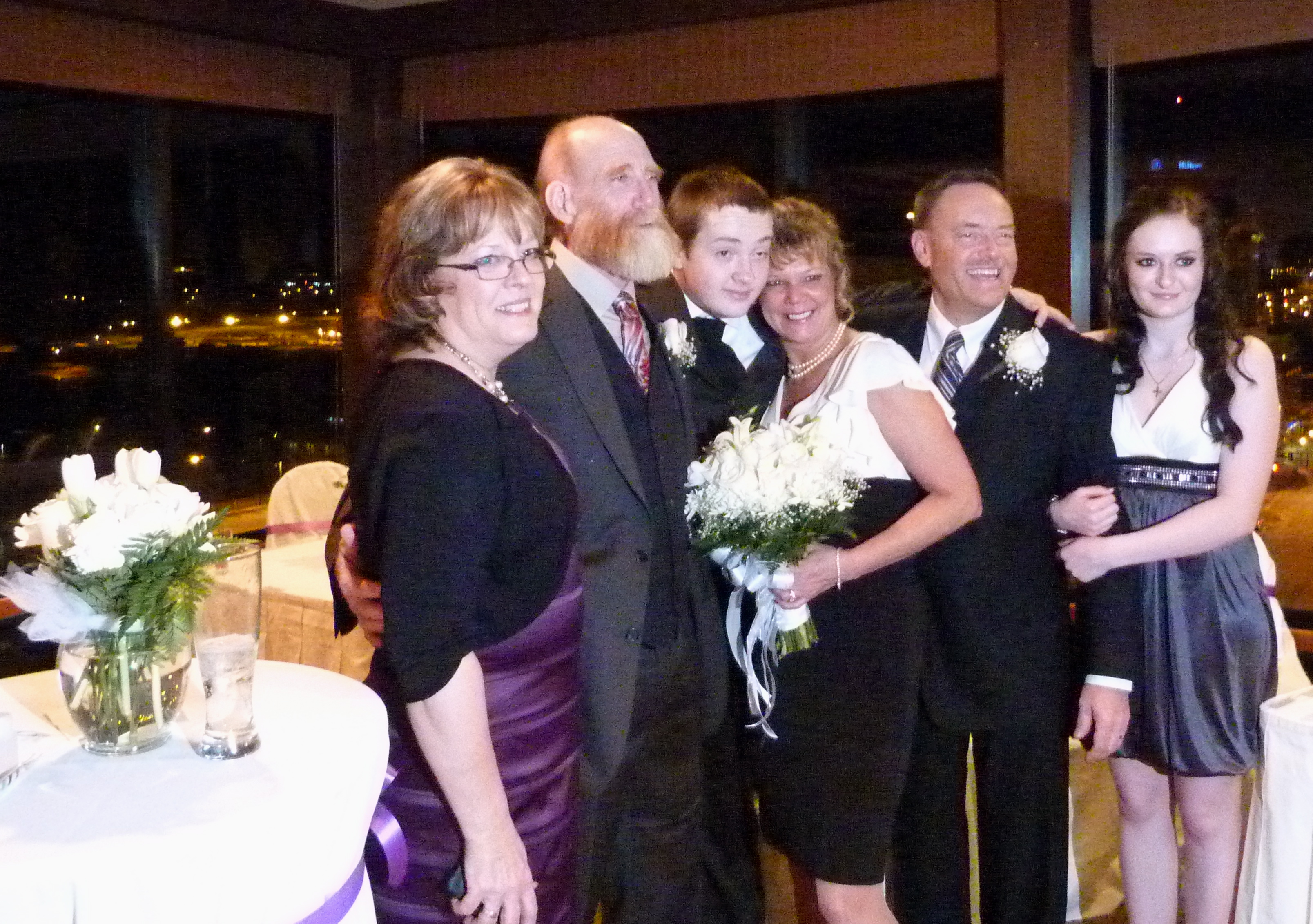
The wedding party. From left, Joan, Gary, Michael (Glenn's son), Terri, Glenn and Danielle. Terri still has the bouquet!

We relaxed with friends and family the day after the wedding, and on Friday we did laundry at the laundromat (running four washers at a time makes quick work of it, even when you have several weeks of dirty clothes) and shopped for provisions. Circling the Costco parking lot and sitting through green lights while young men pushed cars out of icy, snowy intersections made us even more eager to get home. It had snowed eight inches overnight, but later in the day the skies cleared. We left at 7:30 on Christmas Eve morning and got home by 2:30. The return trip was quicker since we didn’t have a dead car battery to contend with.

Once we were home, Gary put the kindling he’d prepared to good use. I put one of my stock pots of filtered ice on the stove and began moving frozen food we wanted to keep frozen out onto the porch. Well-traveled Subway sandwiches don’t sound like a great Christmas Eve dinner, but they were easy. It would still take a good day to unpack everything else, put away weeks of laundry, and restock our water supply. But what did the calendar mean to us now, home alone together in our little cabin?

Sunrise: 10:36 a.m.
Sunset:
3:23 p.m.
Weather:
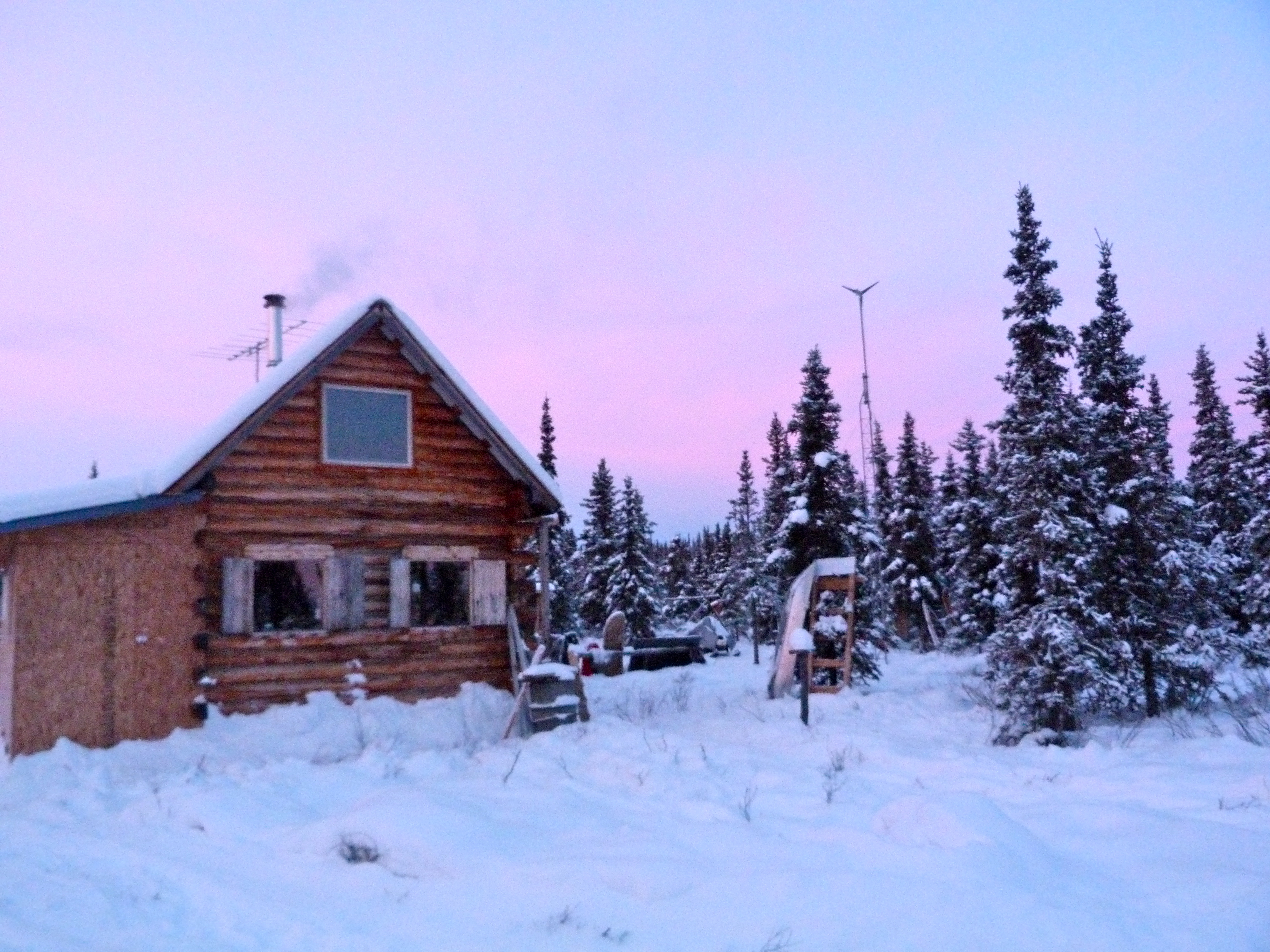
High 4°, low -25°, with most of the day hovering around the low; yesterday, too. But sunny and beautiful, the mountains brilliant and the sun’s higher arc in evidence as sun starts to hit Glenn’s cabin.

Sights and Surprises December 28, 2011

Signs of Life

Every day we see the tracks of neighboring wildlife, but they appear in sharpest relief when snow has obscured our own footprints. A snowshoe hare seems to live in our yard, perhaps attracting the fox who visits occasionally. Moose browse the riverbanks, and caribou sometimes pass not far from the wind turbine. Smaller tracks suggest martens, voles and birds – Canadian jays, magpies, chickadees, ravens, spruce grouse and ptarmigan. The birds sometimes leave wing marks in the snow, perfect snow angels.

The single track belongs to the fox; a snowshoe hare has visited, too. The fox may have been hunting birds, which seek out open water.

We don’t see the animals themselves as often as we’d like, but on Saturday as we made our way home on the snowmachine leg of our trip back from Anchorage we saw seven moose. New snow fell in our absence, and as snow deepens moose increasingly use the road.

The day after Christmas as I was filling my water buckets I looked up from the watering hole to see Ella standing stock still, attention focused, paw pointing. I turned to see a large cow moose browsing the opposite riverbank.

I didn’t have my camera with me, so I told Ella to stay with me as I crawled up out of the watering hole’s ice room on my belly, not rising until I was well  under the cover of the woods. I ran to the cabin and came back quietly, Ella on my heels. I went out onto the river; the moose saw us, but didn’t startle. Ella looked at me and then toward the cabin as I shot photos; she seemed to be offering to go get Gary. She could see I was wasting a perfectly good shot, using a camera instead of a rifle.

Bonfire

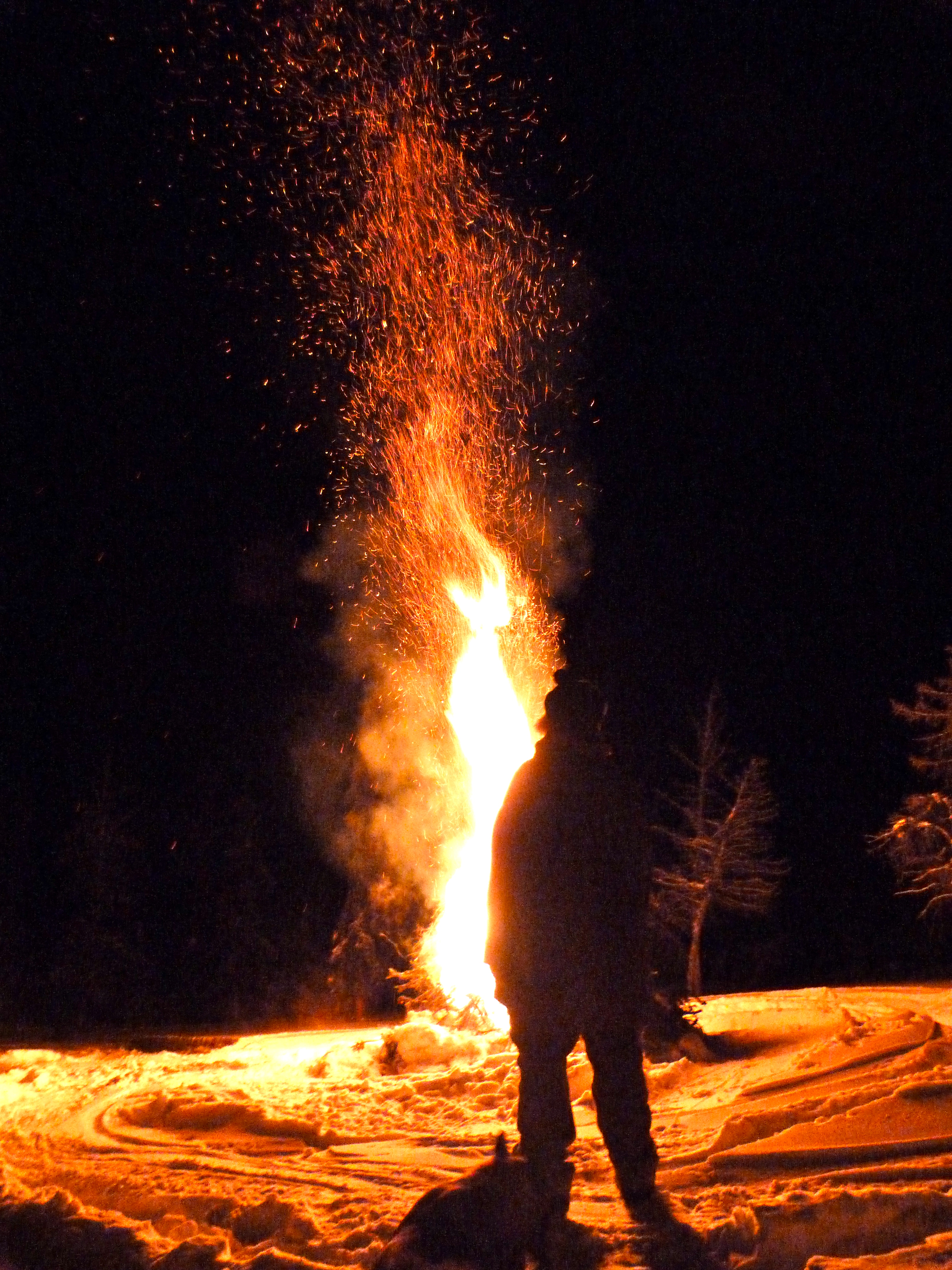
When Gary cut down the trees blocking the sun from our solar panels and the wind from our turbine (see “Men in Trees,” October 2011), we filled our big red sled several times with the debris. The resulting pile had a purpose: it formed the base of our solstice bonfire. Gary added branches from the dead spruce we recently harvested for firewood, and the mound grew. As it turned out, we were away at the solstice—my cousin Glenn’s wedding day—and snow had covered our woodpile. So Gary set about trimming dead branches from trees in our yard this week, and once that was done it was time for the bonfire, before any more snow could fall.

Gary lighting the bonfire

The bonfire stood over six feet tall, not counting a foot or two completely covered by ground snow. Gary lit the fire in three or four places. As it began to take hold, sparks rose high, red lights swirling against black sky. After some time the sparks diminished, and soft gold flames rose from iris blue heat.

Ella chews a stick while Gary watches the bonfire

Ella brought a stick with her, and sat chewing it nervously as she witnessed the destruction of so many potentially fine sticks. Gary and I watched the fire, lost in thought. Ella interrupted us frequently, at times to woof at an unseen animal outside the perimeter of light, but mostly she was talking, wanting to be petted or entertained, or maybe complaining about the pointless waste of sticks. Ella doesn’t often talk, but when she does she’s usually complaining, and it sounds like Charlie Brown’s teacher in the “Peanuts” specials.

“Wuh?” she asked, pointing with her nose for permission to redeem some sticks that had fallen out of the fire’s reach.

A wall of orange-hot branches remained. Gary pulled green boughs from under the snow, working until all the branches were in the fire’s path. I wondered aloud how far our fire might be seen.

A wall of burnt-orange branches glowed as the bonfire began to wane

“When man first orbited the earth, the Bushmen of Australia lit bonfires, and the astronauts saw the Bush ablaze with them,” Gary told me.

We watched awhile longer, and when the blaze was not much bigger than a good campfire we turned home.

Sunrise: 10:39 a.m.
Sunset:  3:15 p.m.
Weather: High 12°, low -4°, calm with light snow.

Aside

Merry Christmas!

Merry Christmas and a happy New Year to all!

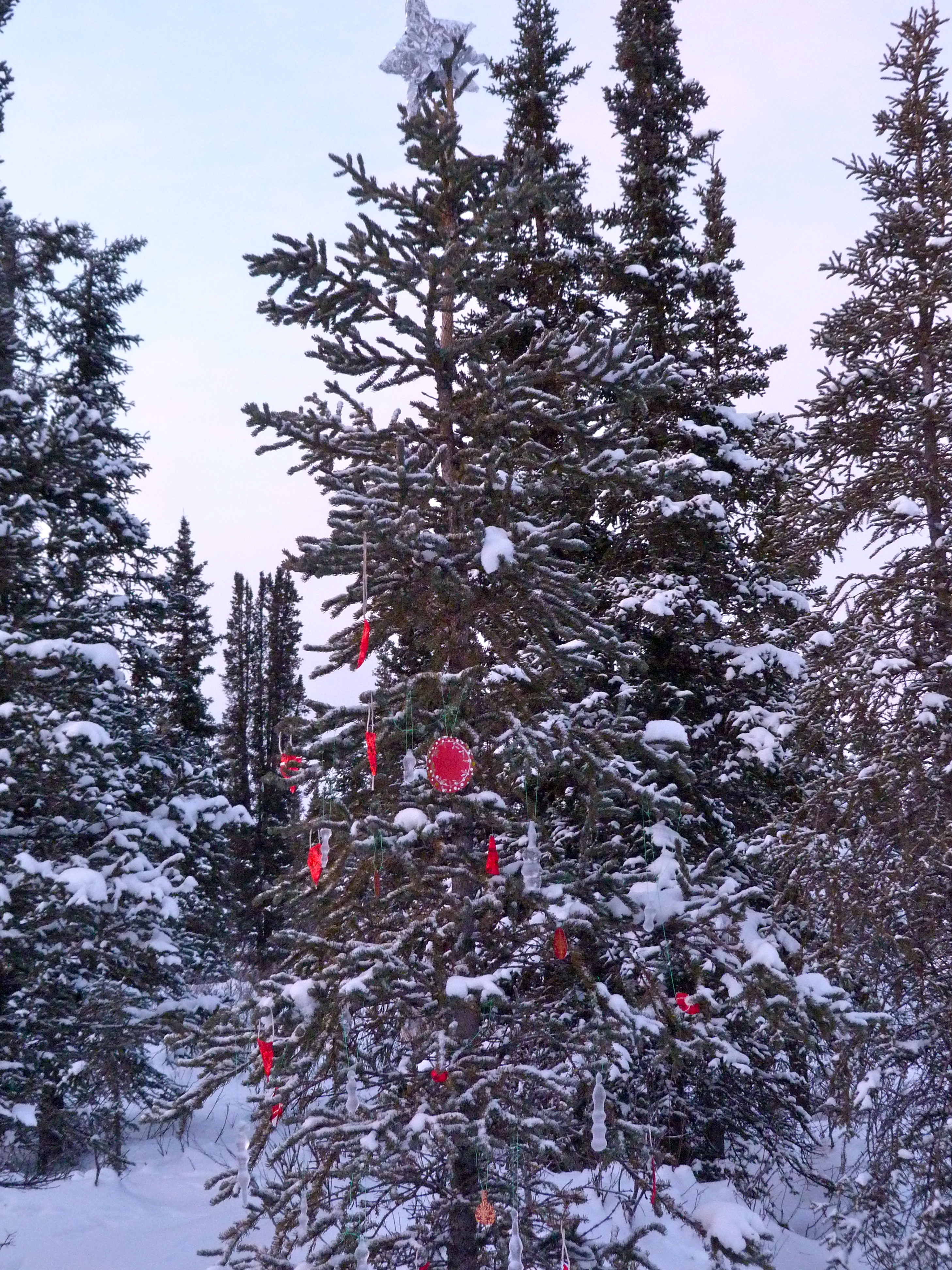
I harvested some of the icicles from my watering hole. Gary heated a wire to put a hole in each for hanging. The rest of the ornaments are from candy wrappers and Christmas cards, plus the aluminum foil star. We just got home yesterday from Anchorage—Gary was best man in my cousin’s wedding on the solstice—so we haven’t gotten around to the popcorn and cranberry garland yet. We were afraid the birds would finish it off before we got the other ornaments up!

The Shortest Days

Tags

, , ,

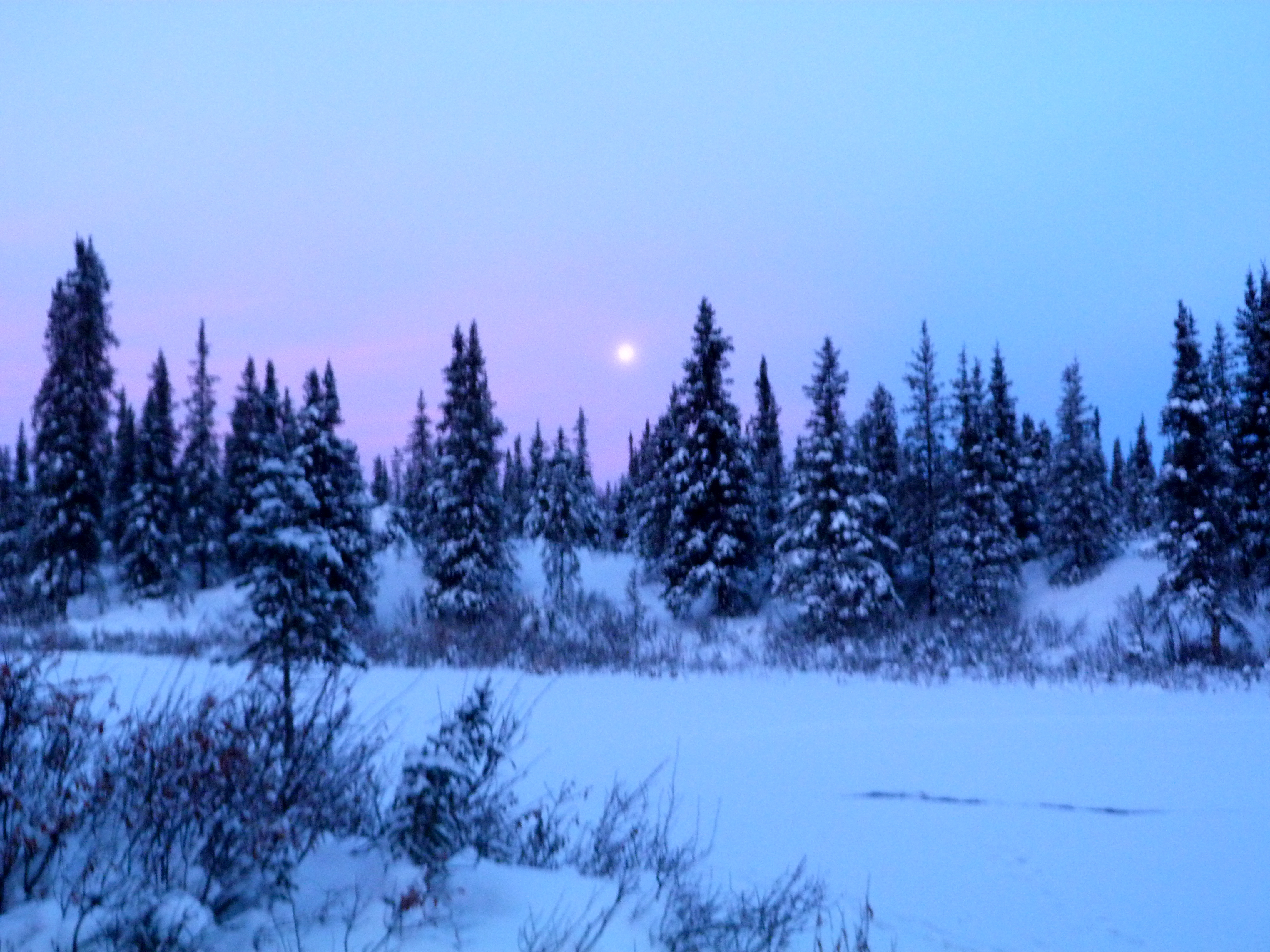
With sunrise coming later and later – it was at 10:38 this morning – I usually wake up once or twice before dawn. Our bed sits high, level with a window, affording an easy view of the night sky and the spruce-covered slope up to our hill. I’ve learned that if I wake to see Orion directly facing me, the time, now in late December, is about 3 a.m. A few days ago I woke to find a bright moon in Orion’s place; it was 7:30, well before first light.

Sunrise comes late and lovely

When I was a kid, my sister Janet once gave me a Snoopy pillow that read, “I’m allergic to morning.” I’ve always loved my sleep. In recent years, though, I learned to rise very early, just before 4 a.m., to make time for my coffee and my thoughts. Then I would head off to the gym or out for a run before turning the rest of my day over to the needs of others at work and at home. In Alaska, with the best of both worlds, I can sleep in and still wake up before the crack of dawn.

I like to be the first one up. Though we keep a chamber pot in the bedroom, I can’t bring myself to use it, so I use a bladder-activated alarm clock. Wedged as I am between the window and Gary, I slide off the foot of the bed, careful to find the floor first, then the opening to the loft’s ladder, which lies just inches away.

Ella greets me as I reach the landing, making it hard to disembark. She used to stay curled up if I got up early or if the fire had gone cold. Now that she’s taken to climbing up on the loveseat after we’ve gone to bed, she tries to sneak down before we can catch her. I stoke the fire, slip on the imitation Ugg boots I got at Costco, and zip up my giant parka. Then Ella and I run outside together, racing back before I have time to wish I’d put on some clothes. Though it’s in the 20’s now, we had a cold snap with several days starting at 38 below. Still, even at those temperatures a quick foray doesn’t require more than a jacket and slipper-boots.

The coffee grinder, with jars of coffee beans at the ready and a loaf pan to catch the ground coffee

Back in the cabin, I grind coffee in an old grain grinder, enjoying the sound and smell and the crunching resistance as I turn the handle twenty-five times for the first of our two pots. Ella and I might sit together on the loveseat as I start my first cup, but she jumps off to greet Gary, who emerges very shortly. Between pots, I make the trip to the raised garden bed in back to dump the spent grounds. Oatmeal and raisins simmer on the stove while Gary and I make our plans for the day. This is our routine every day except Sundays, which we celebrate with buckwheat pancakes, blueberries, and maple syrup. Usually we finish breakfast just after sunrise these days, so we are suddenly alive with activity, keen to capture the daylight.

Blocks of snow cover the crawl space and form a base for banking snow around the cabin

Snow banking is a seasonal chore. A few weeks ago we set about banking the house on all sides with snow for insulation. To cover the crawl space under the cabin, Gary filled apple boxes with snow and left them overnight to set into blocks. But the warmth from inside the house and outside from the sun causes the snow to pull away from the walls, so every few days I mend it with new snow, trying to see how high I can get it to stick.

Despite our best efforts, when it is very cold rime grows on the inside of the windows, and an increasingly solid frost outlines the front door frame. The kitchen drain stopped draining, so until we can figure out whether it’s just frozen or if the underground tank is full, dishwater has to be tossed outside. I know it won’t be long before I slip with the bucket of greasy, oatmeal-y water on my way to the compost pile.

Gary covered as many windows as he could with the foam board he had on hand, and we open the boards every morning to catch any light that may come our way. The rooftop solar panels catch little light as the sun makes its lazy arch lower and lower in the sky, so if there’s no wind we have to keep Internet usage to a minimum, which partly explains the recent gap in my postings.

I once sent Gary a winter solstice card, thinking what a relief it must be to know that the days would begin to grow longer. He answered that he always felt a bit sad knowing the daylight would start eating away the dark. For the first time, I think I understand. The short days give a happy sense of urgency, whether to go out in the snow for pleasure or just to use the daylight to get things done. I love how the pink shades of sunrise and sunset set the boundaries, soft boundaries now as they very nearly join up. And the nights, to my great surprise, are almost light. The snow reflects every ray of moonlight or starlight, and only at the new moon is there any real darkness. We often ski on the frozen river, coming home by the light of the moon. And once we’re home for the night, I love knowing that the darkness will bring time for reading, talking and planning, cooking, eating and sleeping, uninterrupted by the guilt of burning daylight.

Three days to Thanksgiving

Tags

, , ,

By the Tuesday before Thanksgiving, we still hadn’t told Gary’s sister Karen whether we would come. An email from her daughter, Kristen, saying “please please please” promised cheesecake and “maybe” a lemon meringue pie. Our desire to go had been sincere, but now we could taste it.

But our failure to confirm didn’t stem from ambivalence, forgetfulness, laziness, lack of courtesy, or even—my personal favorite—lack of wind power. It was just too cold. Nights dropped to 36 degrees below zero, then 38 below; if temperatures didn’t rise during the day, the wind did.

On the "highway" going to town

So, without a break in the weather, Thanksgiving travel was a non-starter. Literally. We were pretty sure my car wouldn’t start, and dead certain when even the snowmachine balked.

“This is not good,” Gary said. Ella hates swearing, so Gary has developed a gift for understatement.

My car is parked in town, thirty miles away and more than an hour’s travel by snowmachine. It’s not a trip we’d voluntarily make in those temperatures; it’s dangerous in extreme cold to be sitting still, let alone on a machine that creates its own wind chill. But without a snowmachine, we’re truly stranded. In an emergency, we would have to email friends to call one of the local bush pilots, or go out to the road hoping to flag down a passing musher.

The day warmed, the snowmachine started, and we found new energy to prepare for the trip. Our cabin and everything in it would freeze once we left, so we had to deal with anything that wouldn’t survive and ready things to return the cabin to its toasty state quickly when we got back.

On Monday we’d taken care of everything that wasn’t time-sensitive. Some things were basic: changing the bed, gathering six weeks of laundry, tidying, making shopping lists, packing. Gary built a wooden box for Ella to ride in behind the passenger seat. On Tuesday we did the things we’d wish we hadn’t if we did end up staying home: we put away tools, skis, snowshoes, and anything that might walk away (snowmachiners sometimes explore the area) or disappear under a snowfall. Gary began packing the sled with the space heater and battery charger for my car, gas containers to be filled, and coolers to fill with groceries for the return trip. He split birch wood into kindling to start a very hot fire very quickly when we got back. We gathered sleeping bags, fire starter, flashlights, and extra warm clothes in case we broke down on the road.

I focused on food. We had two enormous bags of carrots, several pounds of sweet potatoes, purple potatoes Gary and Karen had cultivated in their mother’s garden during the summer, a couple of onions, a bag of garlic, and a flat of apples, none of which take well to freezing. I must have spent an hour grating carrots, missing my Cuisinart for the first time. When I couldn’t stand grating anymore, I mixed the grated carrots with crushed pineapple and raisins for a salad to take as our contribution to Thanksgiving dinner. The rest of the carrots I blanched in stew-sized chunks, so they would still be sufficiently carrot-like for cooking when we got back. I blanched the purple potatoes, too, and Gary baked the sweet potatoes atop the wood stove in the Dutch oven. The salad and the rest of the perishables he wrapped in a sleeping bag and set in a cooler to make the round trip.

I emptied the water filter for fear its ceramic elements might otherwise crack if they froze. Ella packed her food and dishes—well, someone did, anyway. When we went to bed late Tuesday night, the temperature was eighteen below. Not bad. We were almost ready to go.

Wednesday morning we woke early. Now it was twenty-eight below, pretty close to some unspoken cut-off point. We ate quickly and downed our coffee. We gathered bowls and buckets and pans, pouring in only a couple of inches of water in each; that way the ice wouldn’t warp the containers and it would thaw quickly when we got back. Gary finished packing the sled and carefully tied it all down while I finished dressing.

Arriving at Diane's, where my car is parked

I wore two pairs of long underwear, three pairs of socks, mukluks with two insoles—tufts of hair Ella had been shedding sandwiched between them—a pair of wind-resistant pants, and down over-pants. Then came a wool camisole, a silk turtleneck, a cashmere turtleneck, a Swedish wool zip turtleneck with a long shirttail (sweatertail?) and thumbholes—great for eliminating the gap between mittens and sleeves—and a wool plaid shirt. I waited until I was outside to don the giant hooded synthetic down parka—sold to us with the understanding that it would be uncomfortable in temperatures above zero—a neoprene ski mask, goggles, and a wool hat. I topped all this with a windproof, canvas, knee-length hooded anorak with a thick coyote ruff. Only then could I cover my cashmere-lined leather gloves with bulky wool knit mittens, which went inside gigantic over-mittens.

You may be wondering how I could move or breathe.

I couldn’t.

Ella and I walked to the road while Gary warmed up the snowmachine. I thought he would stop to lock the gate, so I took off my hood and goggles; since I couldn’t do anything with my mittens on, they came off, too. However, as it happened, Gary had no intention of taking time to lock the gate; he had the same problems with movement and overheating—it’s as much a matter of safety as comfort to avoid getting wet with sweat in that weather—and was none too happy about waiting while I struggled to get my mittens and goggles back on.

I faced backward on the snowmachine for two reasons: to reduce the wind in my face, and to watch and comfort Ella, who is happy to run alongside and then catch a ride in our arms when she tires, but did not want to ride in a box. I stuffed my overly mittened hands into the box next to Ella’s warmth, peering at the passing landscape from beneath my fogged-up goggles. Gary reached back and gave me a reassuring pat on the leg.

After several miles he pulled to the side and stopped. I tried to turn toward him, but only a few of my layers turned with me, so I couldn’t see him. All those hats and hoods create a pretty convincing preview of what my hearing will be like if I live long enough, so when I heard Gary’s voice I assumed he was saying, “A musher’s headed this way,” or “I have to pee.”

But he wasn’t. Frustrated, he shouted, “Look!” and pointed.

I managed to turn enough to see a gorgeous bull caribou in his winter-white cape.

“What did you think I was stopping for?” Gary said, more quietly now that he had my attention.

“No idea,” I said. Even more than a few words seemed difficult with all the layers.

The next time we stopped, I worked harder to get both myself and my clothes to face forward. Good thing, too: Gary wanted to show me a gorgeous view of the Mountain. Here, “the Mountain” refers to Mt. McKinley─Denali. It’s the same as San Franciscans saying “the City” when speaking of their town. It would have taken too long for us to dismount and get back on, so I handed Gary my camera.

If I have your address, you will probably get our holiday card with the photo Gary took that day.

View of Denali on our way to town

Less than ten miles later we reached my car. The battery was dead. Even the heater─the one we had brought to heat the engine─wouldn’t start until we thawed it in our friend Diane’s home. I hoped what I saw dripping as Gary carried the heater back to the car was melting ice, but when Diane stepped back inside from feeding her goats, she found me sniffing her floor.

“Uh, we dripped fuel oil on your floor,” I said awkwardly. Confession seemed like the only option.

“That’s OK. Are you kidding? It’s not the first time,” Diane reassured me cheerfully.

Then she pointed out the outhouse, seemingly apropos of nothing. I looked out the window and realized she would have had a perfect view of me peeing out front when we first arrived.

“Oh, great, thanks!” I answered weakly, deciding against confession this time.

A couple of hours work got the battery charged. Gary had transferred everything from the sled to the car, and we were ready to go again, except now the Subaru’s back gate didn’t want to shut tight, leaving us with the interior lights on. Dark was closing in, and we had several hours of driving on snowy roads ahead of us. We unscrewed the bulbs we could reach and drove on. After a while we pulled over, and by then the tailgate was more cooperative.  Soon we were able to get a radio station to come in. A reporter stated that 42 million Americans were traveling over the holiday weekend, most by car. We saw about 42 of them in the first couple of hours of driving.

When we finally pulled in to Karen’s drive it was well after the dinner hour, but we found a warm welcome, pizza, a microwave, and a shower. It wasn’t Thanksgiving yet, but we were very thankful.

Sunrise: 10:32 a.m.
Sunset:  3:09 p.m.
Weather: High 17, Low 7, snow and wind.

Note: In the hustle of the return trip, I lost my camera and the photos for this posting.  When I come up with similar ones, I’ll add them.

Riverdance

Tags

, , ,

I come from a place where the seasons are constrained in an extraordinarily tight and moderate range. San Francisco rarely sees temperatures above 90 or below 40. Seasonal change is comparatively subtle. Autumn leaves drop in the heat of Indian Summer; cherry blossoms appear when the year is new, and reliable old oak trees come into focus on the straw-brown hillsides well before summer fog rolls into the City.

Here I expected a monotony of winter broken mainly by changes in temperature, snowfall and wind. And the freeze-up of the river, I knew that was coming. But I naively imagined ice would spread from the banks inward, simply a thickening layer over the water.

Early ice on the river

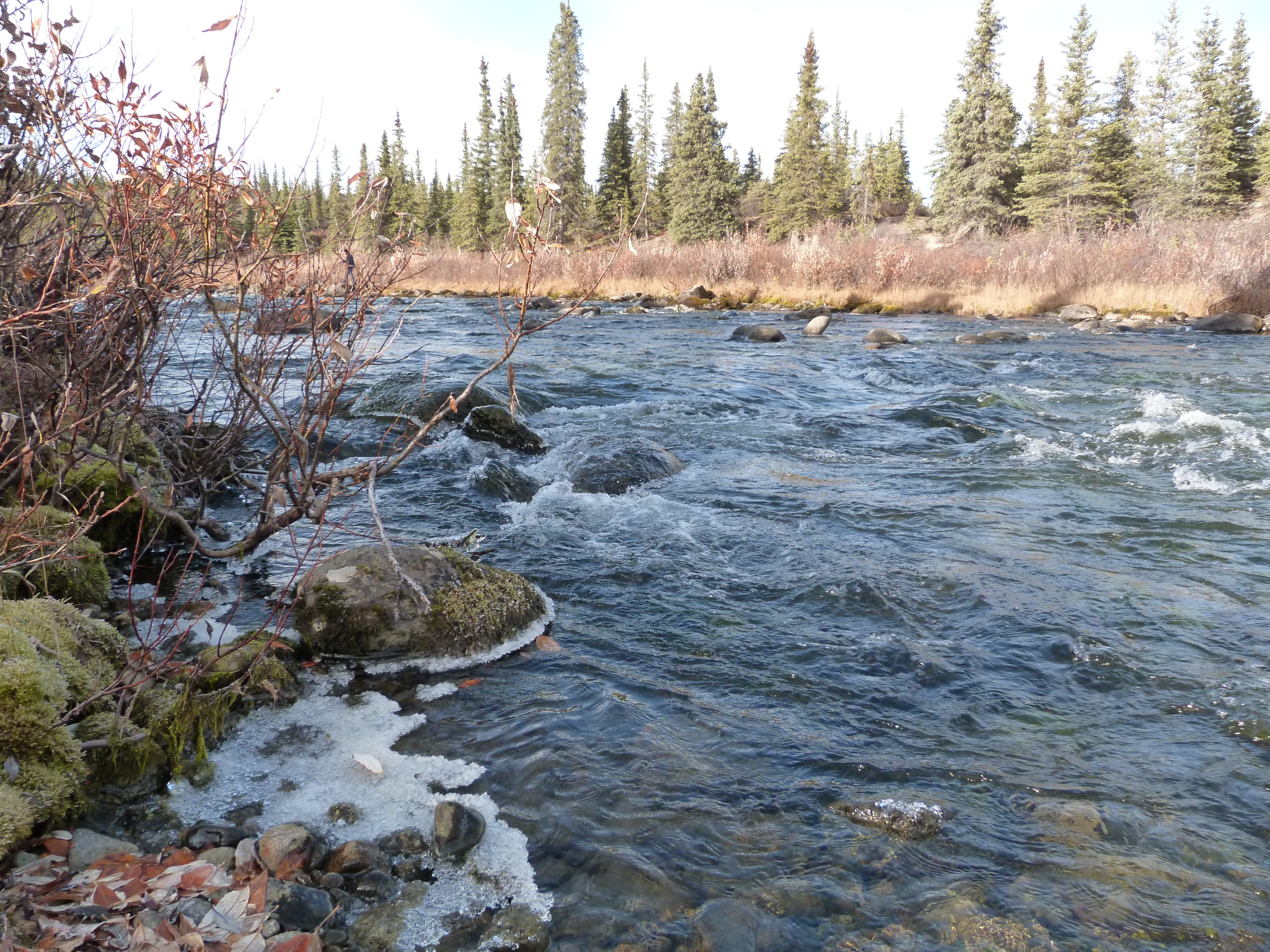
At first that’s what seemed to be happening. One day the stepping stones I had used to get to the clear flowing water in summer had a thin shell of ice. A scenic frost formed around them, and soon ice scalloped the length of the shoreline and began to edge the mid-stream boulders. The rush of water swept young ice into its stream, and I filled my buckets with icewater.

Ladling slush from the overflow

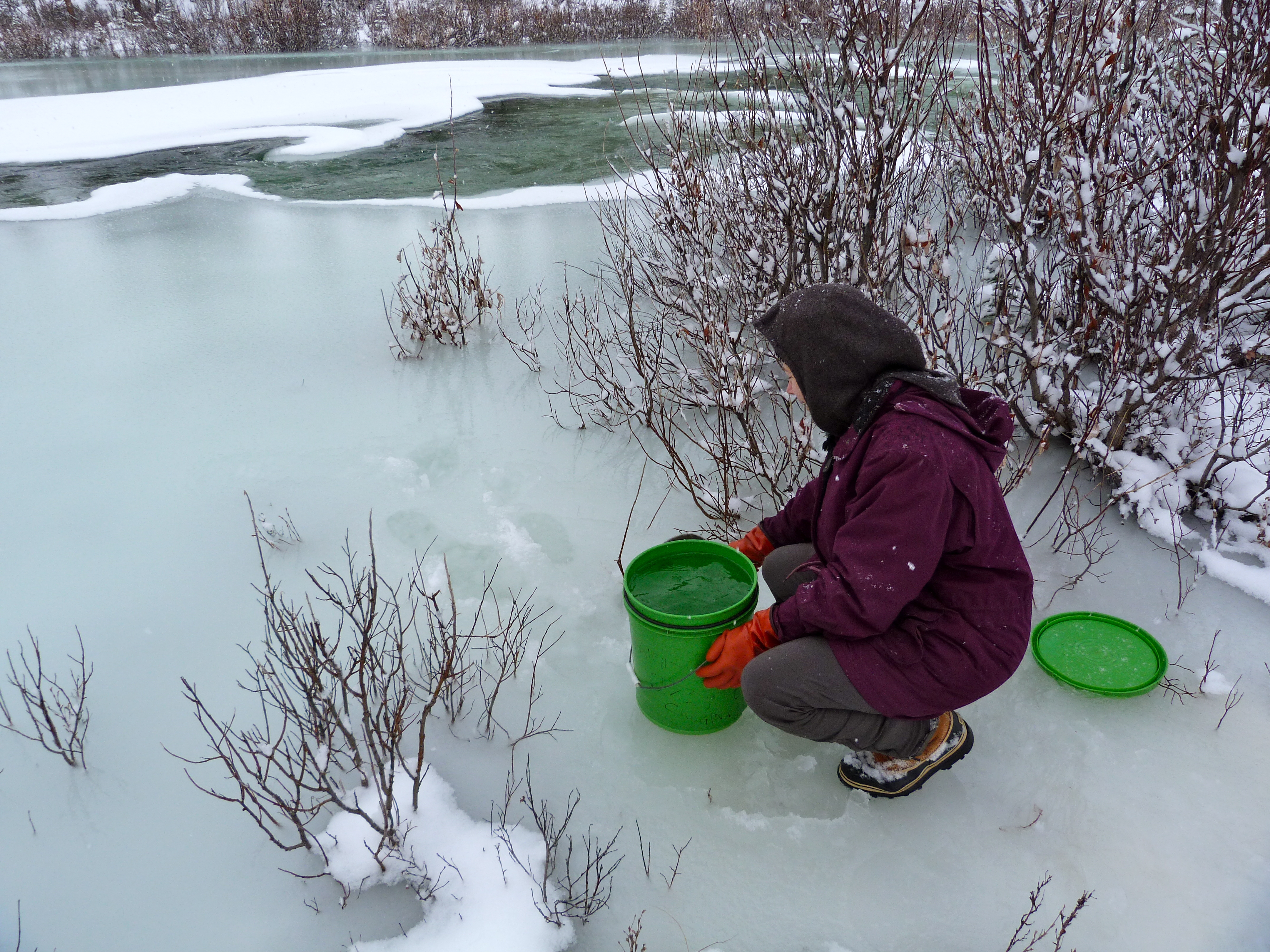
I was surprised by what happened next. Unseen ice forming along the frozen riverbed narrowed the creek’s channels, pushing water up and over the surface crust. Slushy water flowed onto the banks and through the willow brush. I learned to wade cautiously until I found myself in ladle-worthy depths.

Once temperatures dropped close to zero, slush quickly turned to ice. Snowfall covered the slightest crusts, creating the appearance of a river largely frozen over, breached only by a few pools. Under the snow was a patchwork of ice, made thick or thin by forces of air, sun, wind, water and snow. A deep eddy was close to shore; the ice leading to it was solid, so I had an easy filling station for my water buckets. Briefly. A cold snap brought temperatures as low as 38 below zero. High winds made a good excuse not to go out one day and that was enough; the pool had closed.

Surface ice forming on the creek

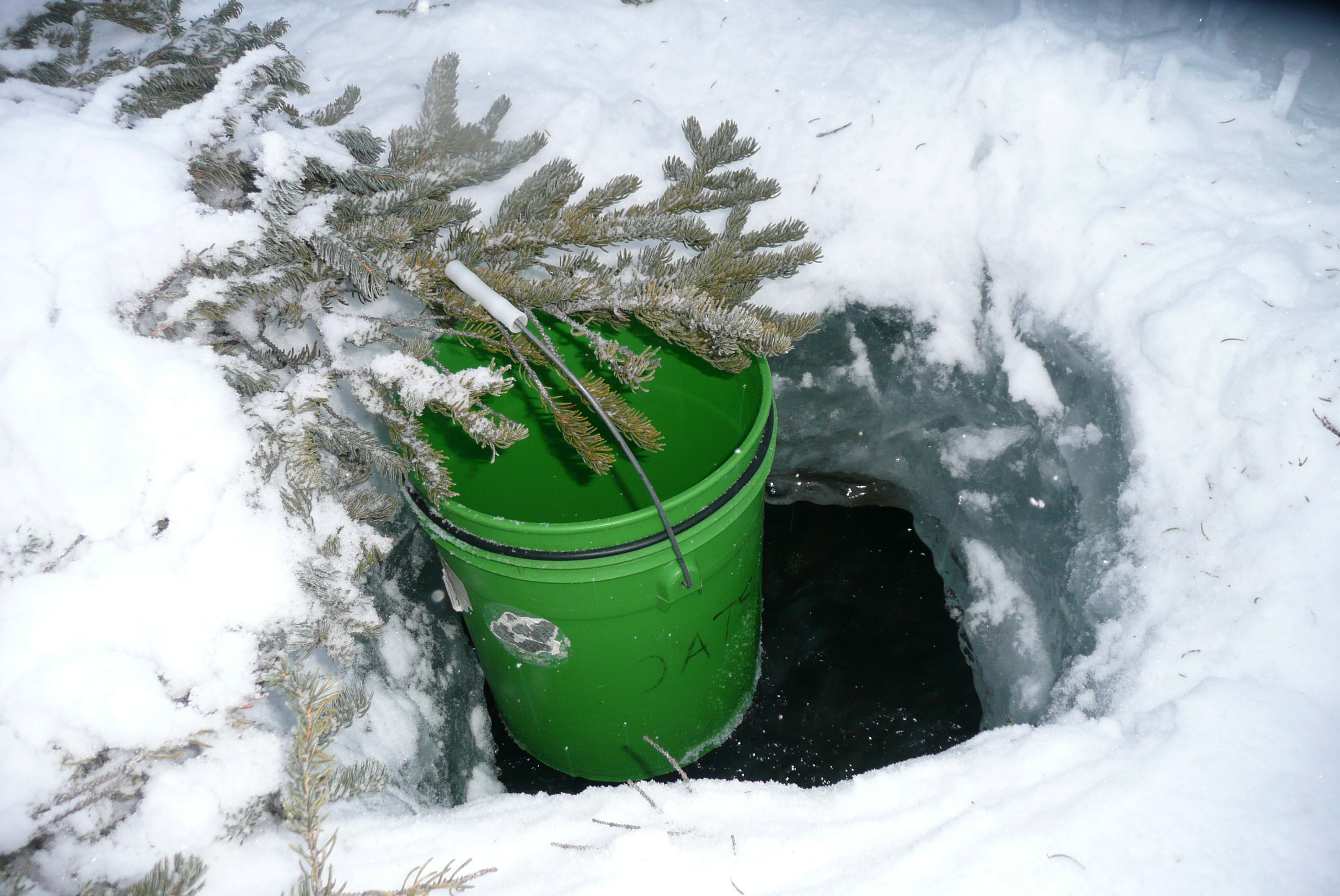
I moved on to the next opening, but the hole quickly became the very definition of a slippery slope, a two-foot perimeter of slick and sloping ice. When I didn’t come back promptly from my water errand one day, Gary found me with the ice chisel, back at my original spot hacking away fruitlessly. Taking over, he chopped through six inches of solid ice. To defend the breach, we laid spruce boughs over it and topped them with an insulating blanket of snow.

We hiked upstream on the riverbed, turning home at sunset

We left to spend Thanksgiving with Gary’s sister and her family near Anchorage. It stayed cold, so we delayed our return and didn’t go back to the creek for a week. Everything had changed. The creek looked as though it had been hit by an earthquake. Long fissures appeared through thick ice along the shore. Its sources frozen, the river rapidly lost volume, leaving nothing to support the surface. Here and there ice had crashed to a new, lower surface; in other spots it had cracked but held, for the moment. Our water hole was intact—if a hole can be intact—perfectly protected by the snow-covered boughs. But the water level had dropped a good two feet; a new layer of ice had formed below. The water was well out of reach.

Ella peers down toward the new watering hole

Our second pool, too, was gone. Heavy ice covering an area about half the size of our kitchen had collapsed down about three feet, revealing a ceiling about eight inches thick. A smaller shelf appears above the floor, making it seem like a room.

Standing quietly, we could hear water. Gary stepped down onto the floor, chopping at it with axe and ice chisel. The ice was about two feet thick. He worked up a sweat, making a hole large enough to dip the bucket in. We brought bigger boughs and shoveled more snow to protect it.

The ice is nearly as thick as the bucket is tall

I love my new watering hole. I can sit on the floor and peer under the river’s surface. Icicles hang from the bottom of the surface ice, and the ice version of stalagmites rise from the floor. It is decorated with crystals and carpeted with snow. I can look right through the sheered edge of the surface ice; transparent blue, it is utterly gorgeous. I hope the ice and water will stay awhile, unaltered. But I know that when I come back to find my ice room changed, something beautiful will take its place.

The ice is transparent where it sheered off; I can see under the river's surface of ice

It may not be convenient, but it will be beautiful.

Sunrise: 10:07 a.m.
Sunset:  3:23 p.m.
Weather: High 28, low 14, light snow off and on throughout the day.

Mushing, Milling and Moonlight

Tags

, , ,

Early season mushers with twelve excited dogs

Snow comes early and stays late on our little highway, making it ideal for dog mushers training their teams for the Iditarod, Yukon Quest, or other long-distance races.

The snow is just now barely deep enough for a sled’s snow brake to take hold, and on some parts of the road perhaps not quite deep enough. Mushers have creative ways to solve for this.
One has thirty-six dogs pulling his truck, which is large enough to serve as a kennel for the team. We’re guessing he uses his brakes downhill to slow, so the truck doesn’t overrun the dogs, and could provide an assist uphill.

A musher travels on snowmobile with sled behind. He looks like he's wearing a bear suit!

With the snow getting deeper now, it’s not uncommon to see a team pulling both a snowmachine and a sled. The musher can ride the sled so long as the snow is sufficient, switching to the snowmachine if needed.

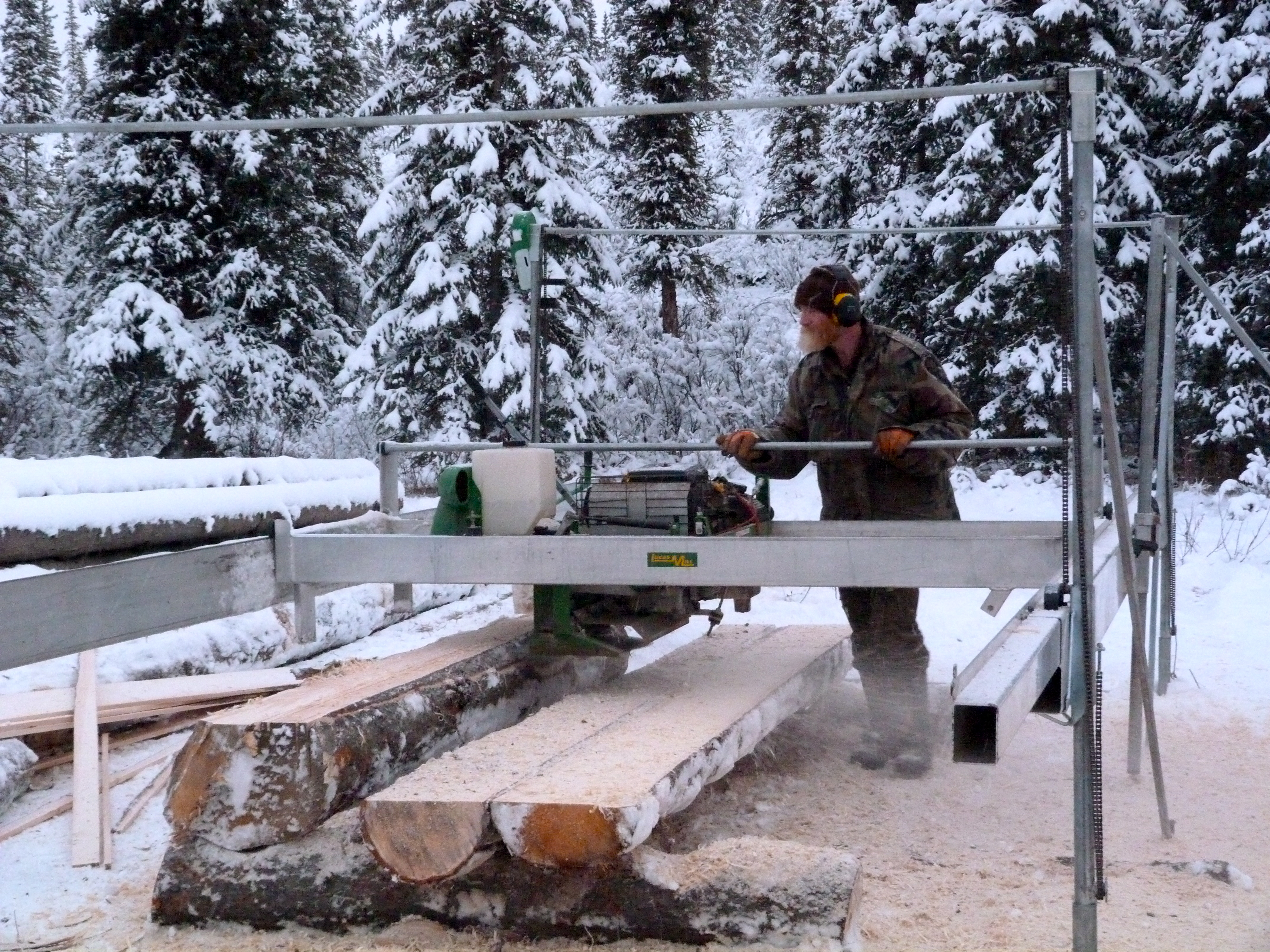
Gary milling spruce for lumber to finish the addition to the cabin and other projects

Gary’s lumber mill is elegantly simple – he was able to show me how to mill a few pieces of lumber myself in just a few minutes. The hard part? Moving ten-foot logs twenty inches in diameter into place. I found it hard to learn how to use a peavey with Gary holding up his (very heavy) end while I tried to get my hook into the log!

Full moon at sunrise, taken overlooking the frozen creek at 8:45 a.m.

If I had to get up early for sunrise, I never would have gotten this shot. This was taken at 8:45 a.m. after the time change.

Sunrise: 9:25 a.m.
Sunset: 3:57 p.m.
Weather: High -18, low -38, sunny and calm. We’re starting to use the ice axe to get to our daily water supply!

The Fog of Winter

Tags

, , ,

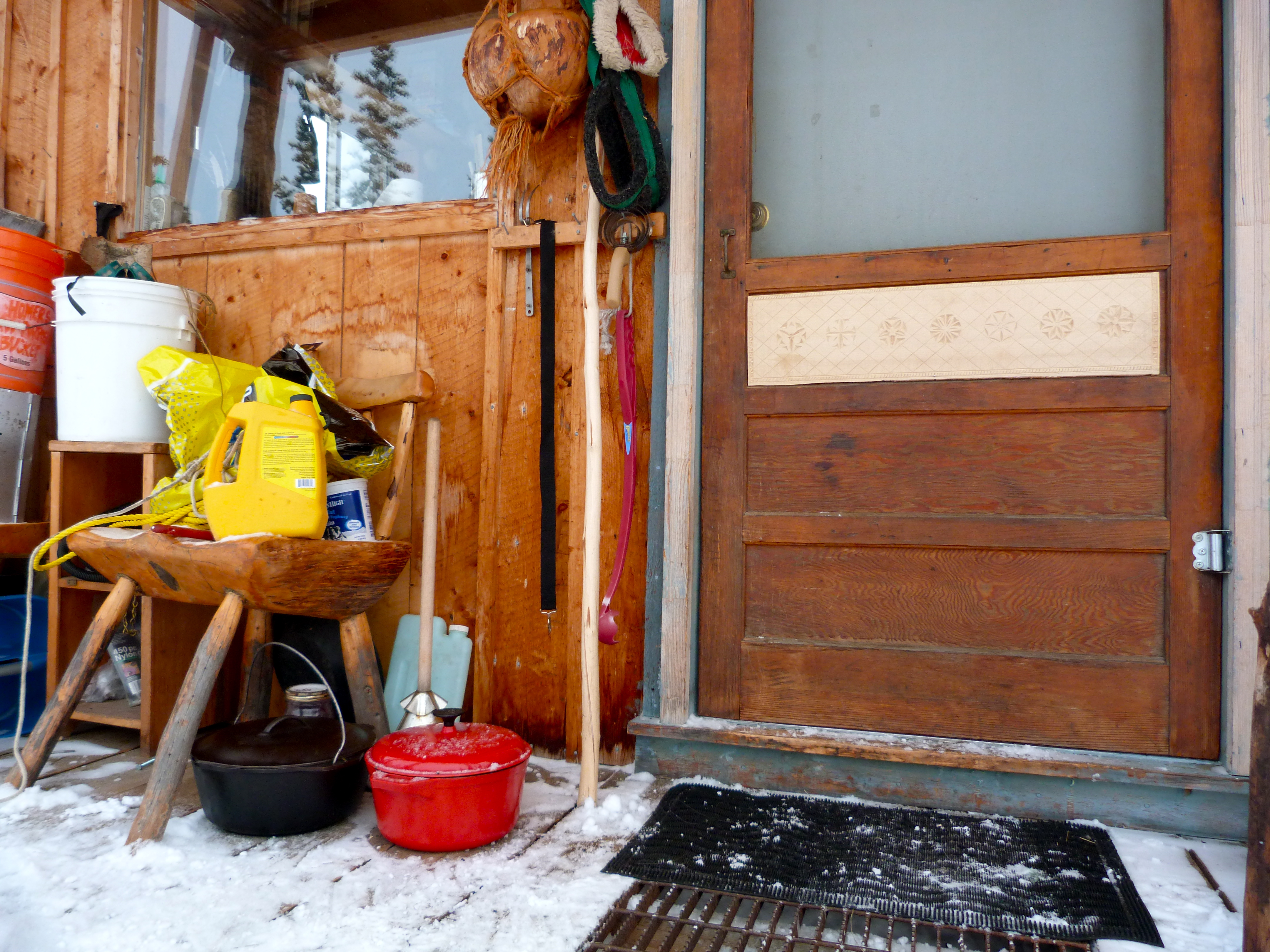
I leaned out the door and snatched the cast-iron Dutch oven from its spot under the chair on the porch. The chair is little-used since the weather turned, but the porch has taken on a new life as our freezer, large enough to hold cheese, cream, chickens and other supplies for the coming months as well as leftovers still in the pot, waiting to be reheated. With a fleet kick I slammed the door shut, but not before a fog had pervaded the kitchen. Fog, yes, but nothing like the wrap that envelops San Francisco, protecting it from extremes – extremes of temperature, anyway. It reminded me of the fog from a commercial freezer. My hand stuck to the knob, just for a second, as I went out again to check the thermometer. Ten below zero.

Dutch ovens in the "freezer"

November is still new; the calendar claims we’re little more than halfway through fall. But if winter isn’t on-scene yet, clearly the stage is set.

I wouldn’t have said that a few days ago. The temperatures had been running in the teens, but, despite a wintry backdrop with a delicate snow cover, the days were crisply autumnal. Still, now, all I need to do to stay warm is dress properly, stay active, and keep the fire going. It’s been gorgeous weather, really. Sunny days are the cold ones now, but they show off the mountains best and tempt us to make time to hike or ski. Cloudy days tend to be warmer, and bring the most beautiful sunsets. Snowy days cover our footprints and make everything clean again.  But I get the impression that a number of my friends in San Francisco agree with my friend and former colleague Steve, who says he would catch the first moose out of here.

Though I find myself startled by the stark shift, it is part of an evolution that has been playing out for weeks and is far from complete. A week or two ago we decided it was safe to turn off the propane refrigerator/freezer so we could close the kitchen windows, which were cracked open to prevent carbon monoxide buildup. With little chance of a thaw now, we can count on the floor space near the door to stay at refrigerator-like temperatures, at least until the nights grow even colder.

The creek changes daily. Ice formed along the shore first, then built up from the creek bed mid-stream. Just as I was gaining confidence that the icy shoreline would hold me while I filled my buckets, I came out one morning to find an overflow of water forced up by the expanding ice left me no choice but to wade in several inches of slush to dip my ladle. This made it harder to know how far I was from shore and how solid the under-slush ice was.  When I got back to the cabin with the water, I fretted aloud about falling in.

I'm ladling water among the willows, which used to be onshore!

Gary was reassuring. “Don’t worry,” he said. “It’s not deep.”

Whereas the ice may or may not be strong enough to hold me, some days it is thick, so I bring a shovel along in case I need to punch through to the water underneath. Lately, though, the overflow has flooded the banks, so the slush I find myself in is in the willow brush.  Gary’s right: it’s not deep.

The sled makes hauling water from the creek easy

I’ve been surprised to see how winter can make things easier. I would much rather pull my heavy buckets on a sled than carry them or push them along in the wheelbarrow. Hauling almost anything, in fact, is easier with the sleds, pulled by hand or snow machine. Cooking is simpler, too; the wood stove is a perfect slow-cooker and warming burner. I have a chicken in the pot as I write, and just hope I remember to pull out the giblets once the bird has thawed enough for me to get at them. The two big stockpots of water on the stove heat quickly and stay warm all day. And with the freezer empty, I have way more storage for pots and pans.

Now we have extra space for pots and pans

Some things, predictably, are harder in winter. But the mattress? We have a Tempur-Pedic—you know, the kind that sort of reshapes itself around you. My side of the bed is next to the window. Though we close the window each morning—the loft can get hot, so we do like the fresh air at night—through some sort of operator error it was left open one cold, windy day. When I went to bed I found that the mattress had, well, solidified. After five or ten minutes it started to yield a bit, so I got comfortable and reached for my water bottle. It was frozen, too.

Getting dressed is a challenge. It’s not just the magnitude of the task—underwear, knee socks, long underwear top and bottom, wool crew socks, pants and top, maybe another top or sweater or two, jacket, boots, hat, hood, glove liners, gloves, and, for some occasions, down over-pants (for cold) or canvas over-pants (for wind and wet snow), anorak, knee-high snow gaiters, mittens, over-mittens and ski mask—but the task of remembering to put things on in the right order. This morning I got all my socks and long underwear on before remembering my regular underwear.  I had to start over. And I’m trying to learn to time it so I don’t go mad in the heat of our toasty cabin with all those layers on.  Once I’m dressed, I’m out. Oops, I forgot my sunglasses.

I’ve been here almost three months. Other than the cold, rainy day when we finally got the wind turbine up and working, I can’t think of a single day that I’ve wanted to stay indoors. At first I waited expectantly for the weather to invite us to spend all day reading by the fire, sipping hot chocolate. Those days may yet come in abundance. But so far it’s been one long stretch of beautiful days, fresh and lovely outside, cozy inside.

Ella enjoys the view on a hike upstream

I had always thought of good weather as sunny, mild days, or beach weather, or the crisp clear days of autumn. What I used to see as bad weather was generally just bad for whatever I happened to be doing or wearing. I’m no longer commuting or having to walk through rain or salty slush in my good work clothes, and I’ve never had to bundle up small children for cold weather. I am learning what to wear depending on conditions and what I’ll be doing. And I’m discovering that beautiful weather can be many things.

“It’s only ten below,” Gary reminds me. “Wait until it’s forty below.”

I can’t wait.

Sunrise: 9:00 a.m.
Sunset:  4:19 p.m.

Weather: High 21, low -4, cloudy with some light snow last night. Early Wednesday morning the temperature dropped to -28!

Snowed In?

Tags

, , ,

Snowy road into town

The Alaska state trooper’s white SUV turned in at our gate. That sealed it: we had to get out, now. We were prepared. I had my heaviest parka, the one that’s uncomfortable in temperatures above zero, in a compression sack, which kept it to a manageable size. A small laundry bag held my warmest hat, mittens, liners and over-mittens, down over-pants, and ski mask. My Subaru was parked outside the gate just across the bridge, facing the road for a quick departure. In its rooftop carrier were sleeping bags, granola bars and other emergency supplies. Gary had put chains on the tires of his truck days earlier. We had hoped for more time, but time had run out.

They put up the warning sign well before the snows came

The light snow that had started falling that morning with the first rays of the sun grew steadier as we packed, more insistent. The trooper’s visit had made it clear: if we didn’t leave now, we might not get another chance.

I didn't have time to unload the sled before it got blanketed in snow

I’d thought we were alone and was surprised to look up from loading the red cargo sled with scrap lumber to see the SUV blocking our drive. I didn’t think to rein in Ella, and she ran to the driver’s door, ready to greet a new friend.

The trooper looked like the law, straight, dark, and serious. He ignored Ella and approached, introducing himself as the local wildlife officer.

“I heard someone was living here. Is it true you’ll be staying the winter?” asked Jim.

“That’s the plan.” I smiled uncertainly and glanced around for Gary.

Ella brought her purple ball and looked meaningfully from Jim to the ball and back.

“I’m your nearest neighbor,” Jim said.

If he was based in town, that put him thirty miles away.

Gary came away from stacking lumber in the nearby shed to join us.

“Is there anyone staying at Gracious House?” Gary asked, not bothering to introduce himself.

“No, he’s looking to sell. They’re gone. Your nearest neighbor out that way is Alpine.”

The folks at Alpine were the ones who fixed my flat tire on the final leg of my move here. That’s sixty miles away.

“What’s the snow looking like out your way?” Gary asked.

“About like this,” said Jim. “Same amount on the ground, too.”

Jim kicked the ball for Ella as he turned back to his car.

“I come through here most every day,” he called. “The road to the east will close tonight, and down my way we have maybe another week, but I’ll be out on the snow machine. I’ll stop in to check on you.”

Jim’s SUV was still pulling out as Gary and I finalized our plans.

“Get ready to go,” he said. “I’ll load the snow machine onto my truck in case we don’t make it.”

It was getting close to 4 p.m. and we hadn’t eaten lunch, but there was no time for that. We had to get my car into town, where we could park it for the winter. Soon—that very night, perhaps—we might not be able to make it out at all except by snow machine. I headed for the house, got my purse, keys, and the two bags of warm clothes, and raced Ella out the gate. I started my car and began clearing it of snow and ice while it warmed up. Only a few minutes after the trooper left, Gary and I locked the gate behind us and drove off, me in the Subaru first, him behind me in the truck.

This was my first time driving in any accumulation of snow. My new, studded tires held me steady as I led the way. I was tense and focused; Ella sensed this and made herself small in the back seat. I’d almost forgotten she was with me until she sat up, at attention, when we stopped for a small herd of caribou crossing the road. I counted ten bulls, cows, and calves. Before I could reach for my camera, they were gone. Just as well—I had forgotten to grab it in the rush.

I drove for more than an hour, keeping watch for Gary’s headlights in my rearview mirror, slowing when I lost sight of them and careful to downshift instead of using my brakes on the snow and ice.

Gary turned off when he reached our friend Diane’s house. Diane and her daughter had kindly offered us a place to park, with access to their electricity by way of a very long extension cord. This winter, when we do need my car, it will take us an hour or two to snow machine in and another hour or so to warm the car, hooking up the battery warmer as well as using our gas-powered portable heater, if we need it, to get the engine warm enough to turn over.

Ella and I watched Gary turn as we drove on. We had hoped to make the trip when the post office was open, in case we had any packages, but at least I could pick up and drop off mail. I stopped at the Tesoro for gas. After filling my tank and a red, six-gallon container, I stopped in to pay and buy a couple of candy bars. I’m always afraid I’ll drive off without paying—it’s hard to get used to pumping before paying!

The Tesoro is even nicer on the inside!

When I stepped into the dirty restroom, though, I heard the voices of Gary and all the others here who prefer their outhouses to indoor plumbing. Lilly can’t even pay for her own liposuction, one scribble decried. Other graffiti was more predictable. I was starting to understand.

I hurried out. The whole place left me so disgusted I drove back to the post office before letting Ella out. We drove back to Diane’s, and though the light was fading I couldn’t resist a hot cup of tea—standing as a way of reminding myself not to linger—before we started our return trip in Gary’s truck. We shared the candy bars and counted the caribou tracks as we drove into the darkness.

Now we’re home alone together, with only each other to talk to. Though the road is officially closed, there’s still some traffic: an occasional hunter, the dog mushers training for the Iditarod or other big races. And the Alaska state trooper: looks like the next time we see Jim, he’ll be on a snow machine.

Sunrise: 8:48 a.m.
Sunset:  4:31 p.m.

Weather: High 29, low 12, snowy, with about 18″ of snow on the ground. Skis and snowshoes are now in use!

Aside

Men in Trees

Tags

, , ,

We’ve been a little disappointed by the contribution of our wind turbine. A Chinook wind came through a few days ago, warming us into the low 40’s. The turbine spun and hummed enthusiastically, but whether the tower’s too short (because we couldn’t manage to get that last ten-foot segment on it), or due to interference from nearby trees, or simply not enough steady wind, the turbine isn’t generating much power yet. That leaves us almost entirely dependent on solar power, though we do have a gas back-up generator.

This is what 11 a.m. looks like!

We don’t use much electricity; we’ve switched back to using propane lights almost exclusively. We might turn on the radio for news in the morning or music in the evening, but that takes very little power. What does require energy is charging batteries on tools and computers, and our internet connection. So I’ll make this post a short one.

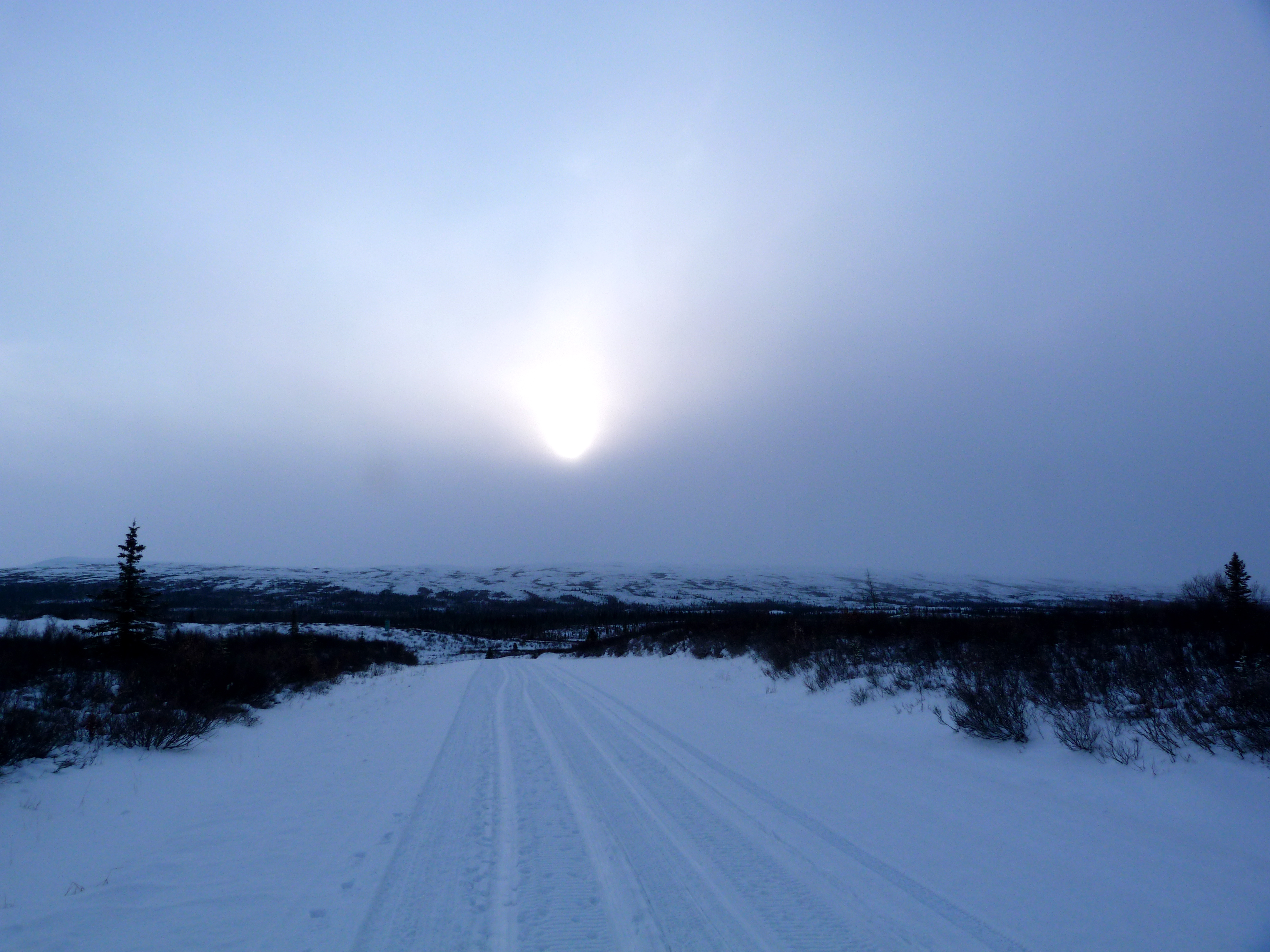
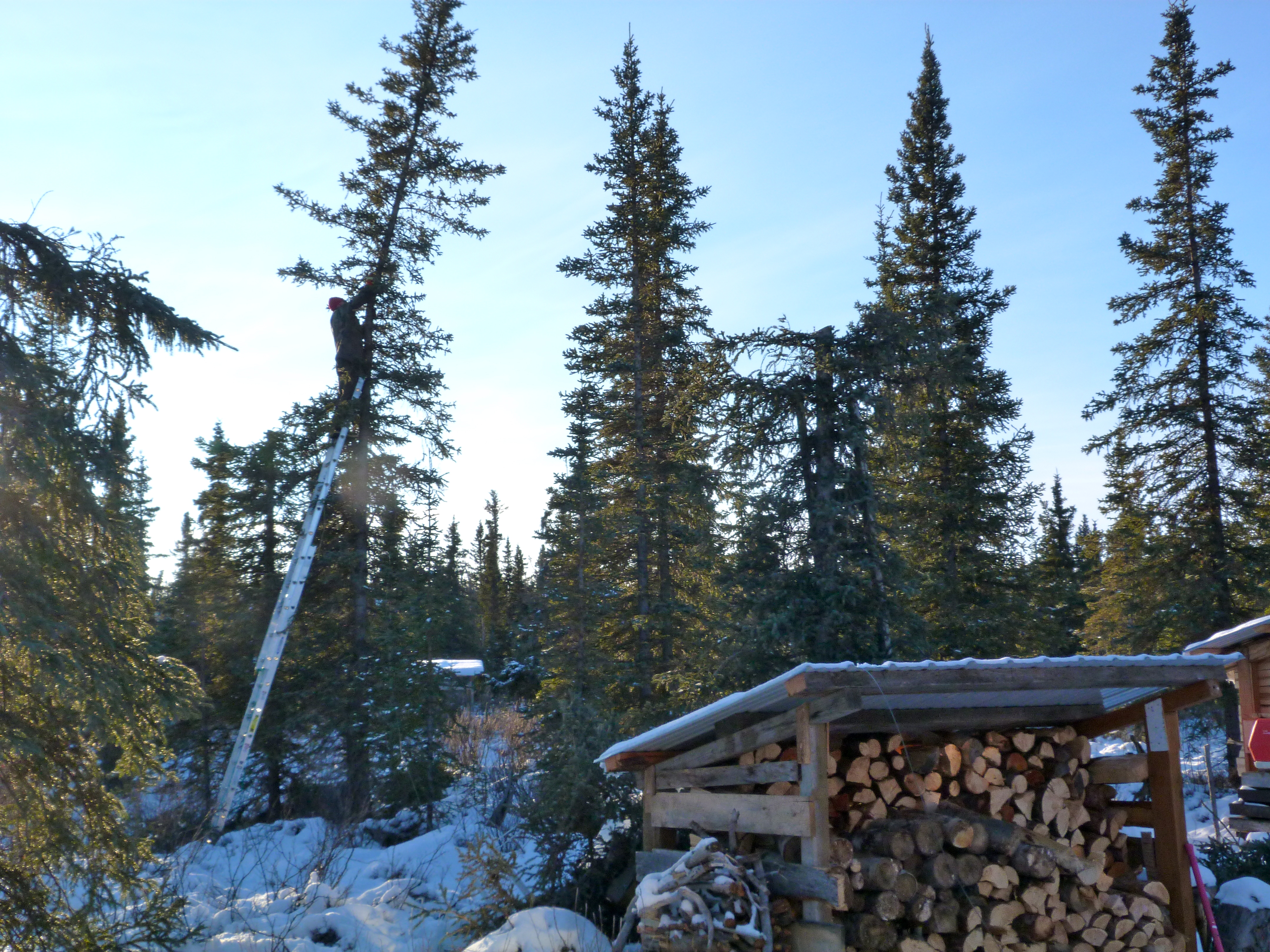
The sun’s trajectory is starkly lower now. No longer strong enough to make the climb over the trees, the sun now peers lazily through them. We discovered that shade was putting the panels to sleep by mid-day. As much as we hated to do it, we had to top off several nice trees and cut down a large old stand entirely. Gary being the only one actually doing anything, he really hated to do it.

Gary on the ladder with his hand saw topping an offending tree

The spruce forest has grown up fast around our place; pictures from the sixties show very few trees. Now hundreds of shrub-high trees foretell an increasingly forested future, so we know what we cut will grow back. Still, it doesn’t escape us that no matter how small we try to make our footprint on the environment, we are cutting down trees for lumber, firewood and, sometimes, simply because they are in our way.

Sunrise:  9:20 a.m.
Sunset:  5:59 p.m.
Weather:  High 10, low -2, sunny and hazy. No wind.